It’s the third time this month that a teacher has reported a strange smell near the senior block restrooms. The vice principal walks over, but by the time anyone arrives, the corridor is empty and the smell has faded. No student was caught. No incident report can be filed with any certainty. And yet, everyone on staff suspects what’s happening.
This scenario plays out in schools across the UAE with growing frequency. Vaping among teenagers has become one of the more difficult behavioral challenges school administrators face today — not because the problem itself is new, but because it’s nearly invisible. Unlike smoke from traditional cigarettes, vapor from e-cigarettes:
- Dissipates quickly
- Often carries fruity or sweet scents that can be mistaken for air fresheners
- Leaves behind little physical evidence
For school leadership, this isn’t just a disciplinary inconvenience. It touches on:
- Student health and wellbeing
- Parental trust
- Regulatory compliance with UAE education authority guidelines
- The broader reputation of the institution
A school that’s seen as unable to manage student safety in its own restrooms faces uncomfortable conversations with parents, governing boards, and sometimes regulators.
This article looks at why vaping detection has become such a persistent challenge for schools, what it actually costs institutions in terms of time, resources, and reputation, and how modern sensor-based monitoring is helping administrators address the issue in a way that’s proportionate, private, and effective.
Understanding the Problem
Why Vaping Is Hard to Detect in School Settings
Vaping presents a unique enforcement challenge compared to other student safety issues. A few factors make it particularly difficult for school staff to manage:
Vapor disperses quickly. Unlike cigarette smoke, which lingers and clings to clothing and surfaces, e-cigarette vapor often clears within minutes. By the time a staff member investigates a tip-off or notices a smell, there’s frequently nothing left to find.
Devices are easy to conceal. Modern vape devices are small, often disguised as USB drives, pens, or other everyday items. Students have become adept at hiding them quickly, and many devices produce minimal visible vapor when used discreetly.
Restrooms and changing areas are blind spots. For obvious privacy reasons, schools cannot install cameras in restrooms, locker rooms, or changing facilities. These are precisely the locations where vaping incidents most commonly occur, which means traditional surveillance approaches simply don’t apply.
Peer culture discourages reporting. Students who witness vaping among classmates are often reluctant to report it, whether due to social pressure, fear of being labeled an informant, or simply not wanting to get involved.
Common Causes Behind the Rise
Several factors have contributed to vaping becoming more common among school-age students in the region:
- Easy access to flavored vape products through informal channels, despite age restrictions
- Misconceptions among teens that vaping is “safer” than smoking
- Social media trends normalizing vape use among younger demographics
- Limited physical evidence making it easy for students to underestimate consequences
Why Schools Struggle to Address It
Many schools rely on staff vigilance, random locker checks, or reactive investigations after a complaint. The trouble is that these methods depend on someone being in the right place at the right time — which rarely happens given how quickly vapor disperses and how brief most vaping incidents are.
Administrators are also working within real constraints:
- Staff are stretched across teaching, supervision, and administrative duties
- Increasing physical patrols of restrooms isn’t a sustainable use of teacher or facilities staff time
- Increased patrols can feel invasive and create an uncomfortable dynamic between students and staff
Impact on Schools
Financial Impact
While vaping itself doesn’t carry a direct cost line item, the downstream effects do. Schools often see increased costs related to:
- Replacing or repairing smoke detectors triggered or disabled due to vape activity
- Additional cleaning and odor management in affected restrooms
- Staff time spent on investigations, parent meetings, and disciplinary processes
- Potential liability exposure if a health incident occurs and the school cannot demonstrate it had reasonable monitoring in place
Operational Impact
Every hour a deputy principal or facilities manager spends on vaping-related issues is an hour not spent on other priorities:
- Investigating vaping reports
- Reviewing CCTV footage from corridors — which rarely shows anything conclusive
- Coordinating with parents
Over a term, these incidents accumulate into a meaningful drain on administrative bandwidth.
Student and Parent Impact
Parents increasingly expect schools to demonstrate that they’re taking student wellbeing seriously, including around substance use:
- A school that appears unaware of — or unable to address — vaping on its premises can face difficult conversations during parent-teacher meetings or formal complaints
- For students themselves, an environment where vaping goes unchecked can normalize the behavior, making it harder for those who don’t want to participate to avoid social pressure
Compliance and Risk Implications
UAE education authorities, including KHDA and ADEK, place strong emphasis on student health, safety, and wellbeing as part of school inspection frameworks:
- Schools are expected to demonstrate proactive measures around student safety
- An inability to address a known issue like vaping can reflect poorly during inspections or accreditation reviews
Traditional Approaches and Their Limitations
Most schools currently rely on a combination of the following methods:
Manual restroom checks. Staff or facilities personnel periodically walk through restrooms and changing areas. This is labor-intensive, only provides a snapshot in time, and students quickly learn the patrol patterns.
Smoke detectors. Standard smoke detectors are not designed to detect vape aerosol and often don’t trigger at all, since vapor particles differ significantly from smoke particles produced by combustion.
Student reporting and peer accountability programs. While valuable as part of a broader culture of safety, these depend on student willingness to come forward — which is often inconsistent.
CCTV in corridors. Cameras placed outside restrooms can sometimes capture students entering or exiting, but they:
- Cannot confirm what happened inside
- Don’t help in areas like changing rooms where cameras aren’t appropriate at all
The common thread across all these approaches is that they’re either reactive (responding after a complaint), inconsistent (depending on staff presence), or simply ineffective at detecting vapor itself.
How Smart Sensors Help
Purpose-built vape sensors offer a meaningfully different approach. These devices are designed specifically to detect the chemical signatures and particulate changes associated with vape aerosol, distinguishing it from normal air conditions.
Real-Time Visibility Without Cameras
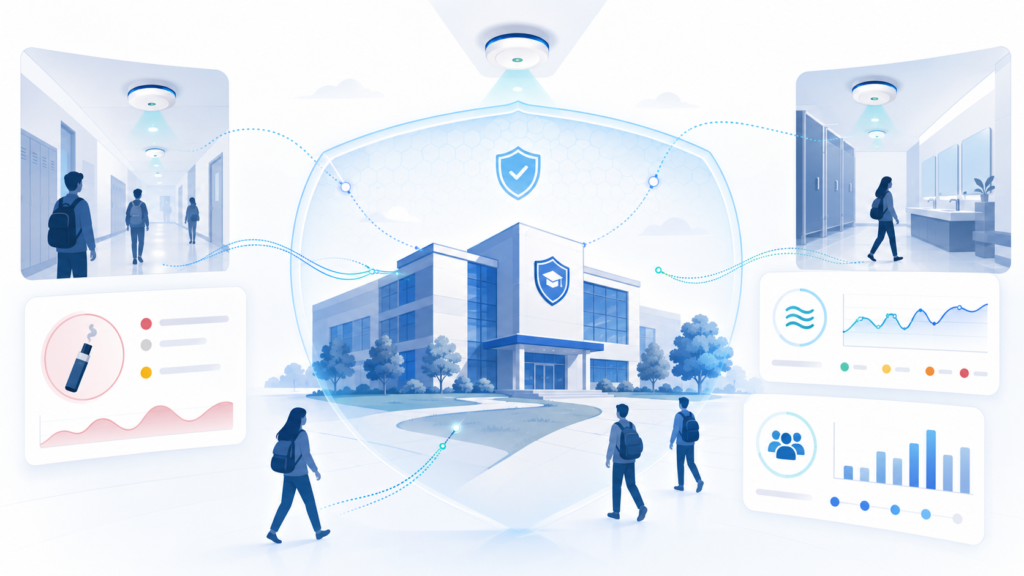
Vape sensors are typically installed discreetly in ceilings of restrooms, changing rooms, and other sensitive areas where cameras cannot be used. They:
- Monitor air quality continuously
- Identify when vape aerosol is present
- Send an alert to designated staff in near real time — often within seconds of detection
This means a facilities manager or duty staff member can be notified that vaping has occurred in a specific restroom at a specific time, without needing to be physically present or relying on someone walking past at the right moment.
Proactive Rather Than Reactive Management
Instead of waiting for a complaint or a chance discovery, schools gain the ability to respond while the situation is still current. If an alert comes through during a class period, staff know roughly which students were likely in that area at that time — based on class schedules and hall pass logs — making follow-up conversations more grounded and less speculative.
Data-Driven Decision Making
Over time, sensor data builds a picture of when and where incidents are most likely to occur. This might reveal patterns — for example, a particular restroom near a specific year group’s classrooms, or a tendency for incidents to cluster around certain break times. Administrators can use this information to:
- Adjust staff supervision schedules during higher-risk periods
- Identify which locations may benefit from additional awareness campaigns
- Demonstrate to parents and boards that the school has a structured, evidence-based approach to the issue
Privacy-Conscious by Design
Importantly, these sensors:
- Do not use cameras or microphones
- Do not identify individuals
- Detect changes in air composition, not people
This makes them appropriate for use in restrooms, changing rooms, and other private spaces where traditional surveillance would be inappropriate or even prohibited.
Key Benefits
Improved Student Safety
Early detection allows staff to address vaping incidents before they become habitual, supporting earlier intervention and access to wellbeing resources for students involved.
Better Operational Efficiency
Facilities and pastoral care teams spend less time on speculative investigations and more time on targeted, informed responses — freeing up capacity for other priorities.
Cost Savings Over Time
By reducing reliance on constant manual patrols and minimizing damage from disabled smoke detectors or improvised vaping setups, schools can see a reduction in related maintenance and staffing costs.
Improved Trust with Parents and Stakeholders
Being able to point to a structured monitoring approach — even without disclosing specific incidents — helps reassure parents and governing bodies that student wellbeing is being actively managed.
Better Indoor Environmental Conditions
Many vape sensors also monitor broader air quality indicators, such as:
- Humidity
- Temperature
- Air particulates
This contributes to a healthier overall indoor environment, which is increasingly relevant for schools focused on student wellbeing standards.
Enhanced Decision Making
Aggregated, anonymized data helps school leadership make informed decisions about:
- Where to focus awareness programs
- How to allocate supervision staff
- How to report on safety initiatives during accreditation reviews
Real-World Use Cases for Schools
Senior School Restrooms
A secondary school installs sensors in restrooms used predominantly by Years 10–12. Within the first few weeks, alerts cluster around the mid-morning break period in one particular restroom. The school:
- Adjusts break-time supervision in that corridor
- Introduces a wellbeing session on vaping for the relevant year group
Boarding House Common Areas
In a boarding school setting, sensors placed in shared bathrooms and common rooms help house staff identify when vaping occurs after lights-out, supporting more targeted conversations with students rather than blanket searches of all rooms.
Sports Facility Changing Rooms
A school with extensive sports facilities installs sensors in changing rooms attached to the gymnasium — an area that had previously been difficult to monitor due to its distance from main school buildings and lack of staff presence outside of scheduled PE periods.
Newly Built Campus Wings
During the planning phase for a new academic wing, a school incorporates vape sensors into the building design alongside other environmental monitoring systems, ensuring the new facility starts with proactive safety measures built in rather than retrofitted later.
Frequently Asked Questions
Q1: Do vape sensors record audio or video?
No. Vape sensors detect changes in air quality and chemical composition associated with vaping. They do not capture audio, video, or images, making them suitable for private spaces like restrooms and changing rooms.
Q2: Can vape sensors tell us who was vaping?
Sensors identify that vaping occurred in a specific location at a specific time. They do not identify individuals. Schools typically combine this information with existing protocols — such as class schedules or hall passes — to guide follow-up conversations.
Q3: Will vape sensors also detect regular cigarette smoke?
Many vape sensors are designed to detect a range of airborne particulates and chemical markers, which can include traditional cigarette smoke as well as vape aerosol, though this depends on the specific sensor model and its configuration.
Q4: How quickly do schools receive alerts after a vaping incident?
Most modern systems send alerts to designated staff devices within seconds to a couple of minutes of detection, allowing for a timely response while the situation is still current.
Q5: Are vape sensors difficult to install in existing school buildings?
Most vape sensors are designed for straightforward installation in ceilings or walls and can typically be retrofitted into existing restrooms and changing areas without major construction work, though placement should be planned with input from a qualified installer.
Q6: Do vape sensors require an internet connection?
Most systems rely on a network connection — either Wi-Fi or a dedicated building network — to send alerts and log data. Schools should plan for adequate network coverage in installation areas.
Q7: How do vape sensors fit into a school’s existing safety policies?
Vape sensors are best used as one component of a broader student wellbeing approach, complementing existing policies on substance use, supervision, and pastoral support rather than replacing them.
Q8: Can sensor data help during KHDA or ADEK inspections?
Schools can use aggregated, anonymized data and documented response protocols as evidence of proactive safety measures, which may support discussions around student wellbeing during inspection processes. Schools should confirm specific documentation expectations with their relevant authority.
Conclusion
Vaping presents a genuinely difficult challenge for schools — not because administrators aren’t taking it seriously, but because the nature of the problem makes it hard to see, hard to prove, and hard to address consistently with traditional methods. Manual checks, smoke detectors, and corridor cameras simply weren’t designed for this kind of issue.
What’s changed is the availability of monitoring tools that:
- Respect the privacy boundaries schools must maintain
- Give administrators the visibility they need to act
- Complement rather than replace staff judgment or existing wellbeing programs
- Turn a frustrating, invisible problem into something that can be measured, understood, and addressed
If your school has been relying primarily on staff vigilance and student reporting to manage vaping, it may be worth taking a closer look at which areas of your campus represent genuine blind spots — and whether a more structured monitoring approach could support your existing safety and wellbeing efforts.
How SmartSensors Can Help
SmartSensors.ae works with schools and educational institutions across the UAE to implement environmental monitoring solutions tailored to campus needs. Beyond vape detection, modern sensor systems can provide:
- Indoor air quality monitoring across classrooms, halls, and common areas
- Occupancy monitoring to understand space usage patterns without identifying individuals
- Vape detection in restrooms, changing rooms, and other sensitive areas
- Environmental monitoring including temperature, humidity, and air particulates
- Privacy-safe monitoring designed specifically for areas where cameras aren’t appropriate
- Real-time alerts and reporting so facilities and pastoral teams stay informed without constant manual checks
Curious whether vape sensors are right for your campus? Get in touch with SmartSensors.ae for a no-obligation consultation tailored to your school’s layout and needs.