It’s 2 a.m. and a guest on the 14th floor of a four-star property in Dubai Marina lights a cigarette in their room, leaning out of a sealed window that barely opens. Within minutes, smoke seeps into the corridor. The fire alarm doesn’t trigger because the smoke never reaches a traditional detector at the right concentration. By the time housekeeping notices the smell the next morning, the room needs deep cleaning, the carpet is damaged, and a neighboring guest has already left a one-star review complaining about the smell drifting into their room.
This scenario plays out more often than most hotel operators in the UAE would like to admit. Guest safety issues — whether related to smoking, air quality, overcrowding, or unauthorized access to restricted areas — rarely make headlines, but they quietly affect guest satisfaction scores, operational costs, insurance claims, and brand reputation.
For hotel managers, facility managers, and property owners across the UAE, guest safety is no longer just about fire extinguishers and CCTV cameras. It’s about having real-time visibility into what’s happening inside guest rooms, corridors, and common areas — without compromising privacy. This article explores the operational and financial impact of safety gaps in hotels, why traditional methods fall short, and how smart sensor technology is helping hotels close these gaps quietly and effectively.
UNDERSTANDING THE PROBLEM
Hotel guest safety covers a wide range of scenarios: fire and smoke incidents, vaping in non-smoking rooms, poor indoor air quality, unauthorized room occupancy beyond booking limits, and security breaches in restricted zones like staff corridors, server rooms, or rooftop areas.
Common Causes Behind Safety Gaps
Several factors make these issues difficult to manage in a typical hotel environment:
- Limited visibility into guest rooms. Once a guest checks in, hotel staff have very little insight into what’s happening inside the room until housekeeping enters or a complaint is raised.
- Vaping and e-cigarettes are harder to detect. Traditional smoke detectors are calibrated for combustion smoke, not the fine aerosol particles produced by vape devices, meaning many vaping incidents go completely undetected.
- Air quality issues build up gradually. Poor ventilation, high humidity, or CO2 buildup in rooms and conference halls develops slowly, so staff often only notice when a guest complains of discomfort, headaches, or stale air.
- Reliance on guest or staff reporting. Most hotels still depend on someone noticing a problem and reporting it — by which point the issue has often already escalated.
Why Hotels Struggle to Solve This
Many UAE hotels operate with lean housekeeping and security teams, especially during off-peak seasons. Physical room checks are time-consuming and intrusive, and installing cameras inside guest rooms is not an option — both for privacy regulations and guest trust. As a result, hotels are often reactive rather than proactive, dealing with safety issues only after they’ve already affected a guest’s experience or caused property damage.
IMPACT ON BUSINESSES
Financial Impact
Smoking and vaping violations in non-smoking rooms typically result in deep-cleaning costs, replacement of smoke-damaged carpets, curtains, and furnishings, and sometimes complete room downtime for 24–48 hours. For a hotel charging AED 600–900 per night, even two days of lost room revenue per incident adds up quickly across a portfolio of properties.
Operational Impact
Housekeeping and engineering teams spend disproportionate time investigating complaints after the fact — checking rooms, identifying the source of odors, and coordinating with maintenance for deep cleaning or HVAC servicing. This reactive cycle pulls staff away from other priorities and creates bottlenecks during high-occupancy periods.
Guest Experience Impact
Guests increasingly expect clean, smoke-free, and well-ventilated rooms. A single bad experience — a lingering smoke smell, stuffy air in a conference room, or noise from an overcrowded adjacent room — often translates directly into negative reviews on platforms like TripAdvisor or Booking.com, which can influence future bookings for weeks or months.
Compliance and Risk Implications
UAE hospitality regulations and Dubai Municipality / Department of Tourism guidelines require hotels to maintain non-smoking policies in designated areas and ensure fire safety compliance. Repeated violations, undetected hazards, or failure to demonstrate proactive monitoring can affect a hotel’s standing during inspections and renewals.
TRADITIONAL APPROACHES AND THEIR LIMITATIONS
Most hotels currently rely on a combination of the following:
- Standard smoke detectors — effective for fire detection, but largely blind to vape aerosols and gradual air quality decline.
- Manual housekeeping checks — staff physically inspect rooms during cleaning, but this happens once or twice a day at most, leaving long windows where issues go unnoticed.
- Guest complaints and reviews — by definition, this means the hotel only finds out about a problem after the guest experience has already been negatively affected.
- CCTV in public areas — useful for corridors and lobbies, but cannot extend into guest rooms or sensitive areas due to privacy concerns.
The core limitation across all these methods is the same: they are reactive. Hotels find out about a problem after it has occurred, rather than being alerted as conditions begin to change.
HOW SMART SENSORS HELP
Smart sensors take a fundamentally different approach by providing continuous, real-time monitoring of environmental and occupancy conditions — without cameras, microphones, or any form of visual surveillance.
Real-Time Visibility Without Compromising Privacy
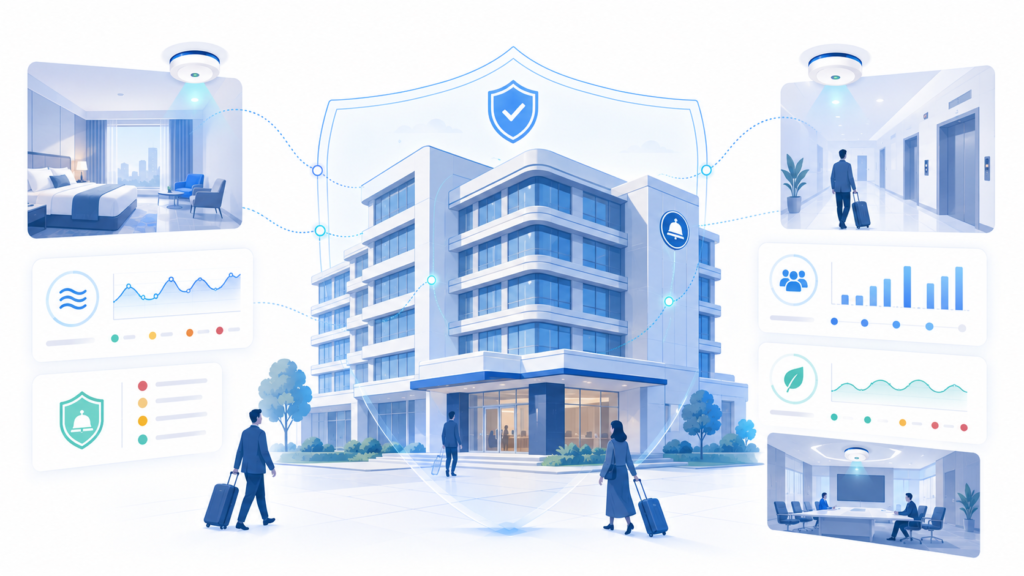
A small wall- or ceiling-mounted sensor can continuously monitor air quality, detect vape aerosols, and track occupancy levels in a room — all without recording images, audio, or any personally identifiable information. This means hotels gain visibility into conditions inside guest rooms while fully respecting guest privacy.
Proactive Alerts Instead of After-the-Fact Discovery
When a sensor detects vape particles, an unusual spike in CO2, or occupancy that doesn’t match the booking (for example, a room booked for two guests showing signs of six occupants), it can trigger an instant alert to the front desk or security team — allowing staff to respond while the situation is still manageable.
Data-Driven Decision Making
Over time, sensor data builds a picture of patterns across the property — which floors experience more vaping incidents, which rooms consistently show poor ventilation, or which times of day see occupancy spikes in meeting rooms. This allows facility managers to make targeted improvements rather than guessing where to focus resources.
KEY BENEFITS
- Improved Safety — Early detection of smoke, vape aerosols, and abnormal occupancy reduces the risk of fire hazards and policy violations escalating into larger incidents.
- Better Operational Efficiency — Housekeeping and security teams can prioritize their time based on real alerts rather than routine, blanket checks across every room.
- Cost Savings — Reduced deep-cleaning frequency, fewer damaged furnishings, and less room downtime translate directly into preserved revenue.
- Improved Customer Experience — Guests enjoy cleaner air, smoke-free environments, and consistent room conditions — all without ever being aware that monitoring is taking place.
- Better Environmental Conditions — Continuous air quality monitoring helps engineering teams fine-tune HVAC performance across different zones, improving comfort in guest rooms, ballrooms, and conference areas.
- Enhanced Decision Making — Property-wide data helps management teams identify trends, justify policy updates (such as smoking zone placement), and demonstrate due diligence during compliance reviews.
REAL-WORLD USE CASES
Use Case 1: Vape Detection in Guest Rooms A mid-size hotel in Abu Dhabi installs sensors in rooms on floors with a history of smoking complaints. Within the first month, the system flags three rooms where vape aerosols were detected shortly after check-in. Front desk staff issue a courteous policy reminder to guests before the situation escalates — avoiding deep-cleaning costs and protecting neighboring rooms from odor transfer.
Use Case 2: Occupancy Monitoring for Booking Compliance A beachfront resort uses occupancy sensors in rooms booked under standard double-occupancy rates. The system identifies a pattern of rooms showing consistently higher occupancy than booked, allowing the revenue team to address unauthorized extra guests — a common issue during peak holiday seasons.
Use Case 3: Air Quality in Conference and Banquet Halls A business hotel hosting frequent corporate events uses environmental sensors to monitor CO2 levels in conference rooms. When levels rise during long meetings, the system alerts the engineering team to adjust ventilation in real time, keeping attendees comfortable and avoiding the common “stuffy room” complaint that often appears in post-event feedback.
Use Case 4: Restricted Area Monitoring A luxury property uses sensors in staff-only corridors and rooftop access points to monitor occupancy without cameras, helping security teams identify unusual after-hours activity while respecting staff privacy in non-public areas.
HOW SMARTSENSORS CAN HELP
Modern smart sensor solutions, like those offered by SmartSensors.ae, are designed to give hotels practical, privacy-respecting visibility into the conditions that matter most for guest safety and comfort. Depending on a property’s needs, this can include:
- Indoor air quality monitoring — tracking CO2, humidity, and particulate levels across guest rooms and common areas
- Occupancy monitoring — understanding room and space usage patterns without cameras
- Vape detection — identifying vape aerosols that traditional smoke detectors typically miss
- Environmental monitoring — supporting HVAC optimization and comfort across different zones
- Privacy-safe monitoring in sensitive areas — covering staff zones, restricted corridors, and back-of-house spaces without visual surveillance
- Real-time alerts and reporting — giving facility and security teams timely information to act on, along with historical data for long-term planning
Rather than replacing existing safety systems, these sensors work alongside fire alarms, CCTV in public areas, and housekeeping protocols — filling the visibility gap that currently exists inside guest rooms and sensitive zones.
FREQUENTLY ASKED QUESTIONS
- Do smart sensors use cameras to monitor guest rooms? No. Smart sensors used for hotel monitoring typically rely on environmental and aerosol detection technology, not cameras or microphones, ensuring guest privacy is fully maintained.
- Can these sensors detect vaping if a guest uses the bathroom or covers the device? Vape detection sensors are designed to identify aerosol particles in the air, which spread through a room regardless of where the device is used, making detection effective even when guests attempt to conceal vaping.
- Will installing sensors require major renovation or rewiring? Most modern sensors are compact, wireless, and designed for retrofit installation, meaning they can typically be added to existing guest rooms without significant construction work.
- How do hotels respond when a sensor sends an alert? Responses vary by hotel policy, but commonly include a front desk reminder about smoking policies, a maintenance check for air quality issues, or a security follow-up for occupancy discrepancies.
- Are smart sensors compliant with UAE privacy regulations? Since these sensors do not capture images, audio, or personal data, they are designed to align with privacy expectations relevant to hospitality environments in the UAE, though hotels should confirm specific compliance details based on their property type and local guidelines.
- Which areas of a hotel benefit most from smart sensors? Guest rooms, conference and banquet halls, staff corridors, and restricted access areas tend to see the most value, particularly where air quality, occupancy, or policy compliance are ongoing concerns.
- Can sensor data help during fire safety audits or inspections? Historical air quality and incident data can support documentation of proactive monitoring practices, which may be useful context during internal reviews or discussions with safety consultants.
CONCLUSION
Guest safety in hotels is no longer just about visible measures like fire extinguishers, exit signs, and CCTV in lobbies. The conditions that most directly affect guest experience and operational costs — air quality, vaping, occupancy, and access to sensitive areas — often happen out of sight, inside guest rooms and behind closed doors.
For UAE hotel operators managing tight margins, high guest expectations, and an increasingly review-driven market, the ability to detect and respond to these issues early can make a meaningful difference — not through dramatic interventions, but through small, timely actions that prevent bigger problems.
If your property is relying primarily on guest complaints, periodic housekeeping checks, and standard smoke detectors to manage these risks, it may be worth assessing where the visibility gaps are — and what they could be costing you in cleaning, downtime, and guest satisfaction.
Suggested CTA: Curious about where your property’s blind spots are? Get in touch with SmartSensors.ae for a no-obligation assessment of your current monitoring setup.
SUGGESTED INTERNAL LINKING OPPORTUNITIES
- Link “vape detection” to a dedicated Vape Detection Sensors product/solutions page
- Link “indoor air quality monitoring” to an IAQ monitoring solutions page
- Link “occupancy monitoring” to a relevant case study or solutions page for hospitality
- Link “privacy-safe monitoring” to a page explaining sensor technology and data privacy approach
- Link “UAE hospitality regulations” reference to a related compliance/blog article if available
FAQ SCHEMA (5 QUESTIONS)
- Q: Do smart sensors use cameras to monitor guest rooms? A: No. Smart sensors used for hotel monitoring typically rely on environmental and aerosol detection technology, not cameras or microphones, ensuring guest privacy is fully maintained.
- Q: Can these sensors detect vaping if a guest covers the device or uses the bathroom? A: Vape detection sensors identify aerosol particles that spread through a room regardless of where the device is used, making detection effective even when guests attempt to conceal vaping.
- Q: Will installing sensors require major renovation? A: Most modern sensors are compact, wireless, and designed for retrofit installation without significant construction work.
- Q: Are smart sensors compliant with UAE privacy regulations? A: Since these sensors do not capture images, audio, or personal data, they align with general privacy expectations for hospitality environments, though hotels should confirm specifics for their property type.
- Q: Which areas of a hotel benefit most from smart sensors? A: Guest rooms, conference and banquet halls, staff corridors, and restricted access areas tend to see the most value for air quality, occupancy, and policy compliance monitoring.