A housekeeping supervisor at a four-star hotel in Deira walks into a “non-smoking” room for the daily clean and immediately catches the smell — stale cigarette smoke, masked with a heavy spray of air freshener, with the bathroom window propped open. The guest checked out an hour ago. There’s no proof, no charge applied, and the room now needs to be pulled from inventory for deep cleaning before the next guest arrives that evening.
This is one of the most common, and most frustrating, problems hotel teams across the UAE deal with on a regular basis. Non-smoking policies exist for good reason — guest comfort, fire safety, and compliance with hotel brand standards — but enforcing them has always been difficult. Hotels can’t install cameras in guest rooms, and by the time anyone notices the smell, the guest is usually long gone and the damage is already done.
For hotel managers, facility teams, and property owners, this isn’t just an occasional inconvenience. It’s a recurring cost that affects room availability, guest satisfaction, and brand standards — and one that’s becoming more complicated with the rise of vaping, which is even harder to detect than traditional smoking. This article looks at why smoking in non-smoking rooms remains such a persistent challenge, what it actually costs hotels, and how smart sensor technology is helping properties address it discreetly and respectfully.
UNDERSTANDING THE PROBLEM
Smoking in non-smoking rooms isn’t usually a case of guests deliberately trying to cause damage. Often, it’s a guest who steps onto the balcony or leans out a window “just for one cigarette,” assuming it won’t be noticed. Increasingly, it’s also guests vaping indoors, often believing — incorrectly — that e-cigarettes don’t fall under the same policy or won’t leave a trace.
Common Causes
- Guests underestimate how smoke and vapor spread. Smoke and vape aerosols travel through HVAC systems, under doors, and into corridors, affecting neighboring rooms even when a guest believes they’ve contained it.
- Vaping is often not recognized as “smoking.” Many guests don’t consider vaping a violation of non-smoking policies, even though the aerosol can trigger the same complaints from other guests and leave residue on soft furnishings.
- Smell fades before detection. By the time housekeeping enters a room — often hours after the guest has left — ventilation, air conditioning, or the guest’s own attempts to mask the smell can mean the evidence is far less obvious.
- No real-time signal. Unless a smoke detector is triggered (which rarely happens with cigarette or vape smoke at normal room levels), there’s no alert system in place — the issue is only discovered through smell, visual signs, or guest complaints from adjacent rooms.
Why This Is Hard to Solve
The core challenge is privacy. Hotels cannot install cameras inside guest rooms, and guests reasonably expect that what happens in their room — short of damage or safety violations — is private. At the same time, hotels have a legitimate interest in protecting their property, maintaining air quality for future guests, and enforcing policies that are clearly stated at check-in. This creates a genuine tension: how do you monitor for policy violations without monitoring the guest themselves?
Most hotels resolve this tension by simply not resolving it — relying on smell, guest reports, and housekeeping observations, all of which happen after the fact.
IMPACT ON BUSINESSES
Financial Impact
Each smoking incident in a non-smoking room typically results in a cleaning fee charged to the guest — if the hotel can prove it occurred while the guest was still present or shortly after. More often, the room requires deep cleaning of carpets, curtains, and upholstery, sometimes including ozone treatment to remove the smell entirely. This can take a room out of inventory for a full day, representing a direct loss of room revenue on top of the cleaning cost itself.
Operational Impact
Housekeeping and engineering teams spend time identifying the source of a smell, assessing whether a room needs deep cleaning versus a standard clean, and sometimes moving the next guest to a different room while remediation takes place — disrupting room assignments across the property, especially during high-occupancy periods.
Guest Experience Impact
Guests checking into a room that smells of stale smoke — even faintly — often request an immediate room change, and many will mention it in online reviews. For neighboring guests, smoke or vapor smell drifting through air vents or under doors can affect their stay even if the violation didn’t happen in their room.
Compliance and Risk Implications
Non-smoking policies in the UAE are often tied to fire safety regulations and hotel brand standards, particularly for international chains with strict environmental and guest experience requirements. Repeated, undocumented violations can make it difficult for hotels to demonstrate that they’re actively enforcing these policies during brand audits or inspections.
TRADITIONAL APPROACHES AND THEIR LIMITATIONS
UAE hotels typically rely on a combination of:
- Standard smoke detectors — designed to trigger at smoke densities associated with fire risk, which means a cigarette or vape device in a well-ventilated room often won’t trigger an alarm at all.
- Housekeeping observation — staff notice smells or visual signs (ash, burn marks, residue) during cleaning, but only once or twice a day, and often after the guest has checked out.
- Guest self-reporting via terms and conditions — hotels include non-smoking clauses in booking terms, but enforcement depends entirely on catching the guest in the act or finding clear evidence afterward.
- Air fresheners and “smoking deterrent” signage — these address guest awareness but do nothing to detect or document actual violations.
The fundamental limitation is timing. By the time a violation is detected, the guest has usually already checked out, the smell may have partially dissipated, and the hotel has little more than circumstantial evidence — making it difficult to charge the guest fairly or take action before the room is affected.
HOW SMART SENSORS HELP
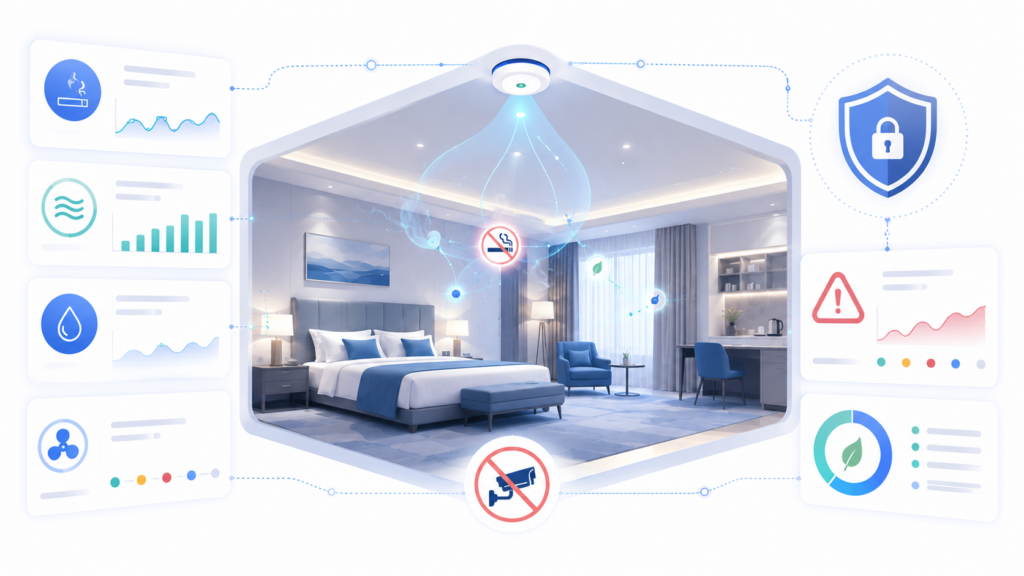
Smart sensors offer a way to detect smoking and vaping incidents as they happen — without using cameras, microphones, or any form of visual monitoring inside the room.
Aerosol and Air Quality Monitoring
A compact sensor placed discreetly in a guest room (typically ceiling or wall-mounted, similar in appearance to a smoke detector) continuously monitors air quality, including the specific particles produced by cigarette smoke and vape aerosols — substances that standard smoke detectors aren’t designed to recognize at low concentrations.
Real-Time Visibility for Staff
When the sensor detects smoke or vape particles, it sends an alert to relevant staff — front desk, security, or duty manager — in real time, while the guest is often still in the room or has only just left. This gives staff the opportunity to address the situation immediately, rather than discovering it during the next cleaning cycle.
Proactive, Respectful Management
Rather than confronting a guest based on a smell that might be ambiguous, staff can approach the situation with confidence based on a documented alert — often resulting in a polite reminder of hotel policy, or, where appropriate, application of a cleaning fee as outlined in the booking terms. The sensor doesn’t record any audio, video, or personal data — it only detects environmental changes in the air.
Data-Driven Policy Decisions
Over time, data from sensors across the property can reveal patterns — certain floors, room types, or even specific rooms with recurring incidents. This helps hotels make informed decisions, such as designating specific floors for smoking-tolerant policies (where applicable) or focusing additional attention on rooms with frequent violations.
KEY BENEFITS
- Improved Safety — Early detection of smoke and vape aerosols reduces the risk of undetected fire hazards and supports overall fire safety compliance.
- Better Operational Efficiency — Housekeeping teams can be directed to rooms that actually need deep cleaning, rather than relying on guesswork or routine inspections of every room.
- Cost Savings — Reduced frequency of deep cleaning, fewer damaged furnishings, and the ability to apply cleaning fees fairly based on documented alerts all contribute to cost control.
- Improved Customer Experience — Guests in non-smoking rooms are less likely to encounter lingering smoke smells, and neighboring rooms are protected from smoke or vapor drifting through shared ventilation.
- Better Environmental Conditions — Continuous air quality data helps maintain consistent, fresh air conditions across guest rooms, supporting the non-smoking experience that most guests expect and value.
- Enhanced Decision Making — Property-wide data on smoking and vaping incidents helps management refine policies, target high-risk areas, and demonstrate proactive enforcement during brand or regulatory reviews.
REAL-WORLD USE CASES
Use Case 1: Real-Time Alert During Guest Stay At a hotel in Abu Dhabi, a sensor in a non-smoking room detects vape aerosol shortly after check-in. The duty manager receives an alert and arranges for a staff member to call the room with a polite reminder of the hotel’s non-smoking policy — addressing the issue while the guest is still in-house, rather than after checkout when nothing can be done.
Use Case 2: Documenting Repeat Incidents for Fair Charging A property in Dubai notices that a particular guest’s room has triggered two smoke detection alerts during a multi-night stay. With this documented data, the front desk is able to apply the cleaning fee outlined in the booking terms with confidence, rather than relying on a housekeeping team member’s subjective assessment after checkout.
Use Case 3: Identifying Patterns Across Floors A resort property reviews several months of sensor data and notices that rooms on one particular floor — closer to outdoor terraces — show a higher rate of smoking incidents. This insight helps the operations team consider additional signage, staff awareness training, or policy reminders specifically for that floor.
Use Case 4: Protecting Neighboring Rooms A business hotel near Sheikh Zayed Road uses sensors not just in individual rooms but identifies, through aggregated data, that vape aerosols from one room are coinciding with air quality changes in an adjacent room — helping the facilities team understand how shared ventilation may be contributing to smoke transfer between rooms, and prioritize HVAC adjustments accordingly.
HOW SMARTSENSORS CAN HELP
Smart sensor solutions from SmartSensors.ae are designed to help hotels address smoking and vaping in non-smoking rooms in a way that respects guest privacy while giving staff the real-time information they need. Depending on a property’s requirements, this can include:
- Indoor air quality monitoring — tracking overall air conditions in guest rooms, including changes linked to smoke or vapor
- Occupancy monitoring — understanding room usage patterns without cameras
- Vape detection — identifying vape aerosols that traditional smoke detectors are not designed to catch
- Environmental monitoring — supporting broader air quality and ventilation management across the property
- Privacy-safe monitoring in sensitive areas — covering guest rooms and other spaces without any visual or audio recording
- Real-time alerts and reporting — giving front desk and security teams timely information, along with historical data to support policy decisions
These sensors are designed to sit quietly in the background, much like a smoke detector, providing useful information only when something relevant changes in the air — without ever observing the guest directly.
FREQUENTLY ASKED QUESTIONS
- Can these sensors tell if a guest is smoking, or do they just detect smoke in general? The sensors detect specific particles and changes in air quality associated with cigarette smoke and vape aerosols, distinguishing these from normal air conditions, though they do not identify who is responsible — that requires staff follow-up.
- Do these sensors record audio or video inside guest rooms? No. The sensors monitor air quality and environmental conditions only — they do not capture any audio, video, or images, and do not collect personal data about guests.
- Will guests be aware that a sensor is monitoring air quality in their room? Sensors are typically discreet, similar in appearance to a smoke detector, and hotels can choose to include general information about air quality monitoring in their guest policies if desired for transparency.
- Can vape aerosols really be detected separately from normal humidity or steam, like from a shower? Modern air quality sensors are designed to differentiate between common sources of humidity, such as steam from a shower, and the specific particle signatures associated with vape aerosols, reducing false alerts.
- How quickly does the hotel get notified after an incident occurs? Alerts are typically sent in real time, often while the guest is still in the room or shortly after, giving staff the opportunity to respond promptly rather than discovering the issue during the next cleaning cycle.
- Can this data be used to charge a guest a cleaning fee? Sensor data can provide documented evidence to support a hotel’s existing cleaning fee policies, though how this is applied should align with the hotel’s terms and conditions and any relevant guest communication practices.
- Do these sensors require any changes to existing smoke detectors or fire alarm systems? No. Air quality and vape detection sensors are typically installed as an addition alongside existing fire safety systems, rather than as a replacement.
- Is this technology suitable for all room types, including suites and connecting rooms? Yes, sensors can generally be installed across different room configurations, with placement adjusted based on room size and layout to ensure effective air monitoring.
CONCLUSION
Smoking and vaping in non-smoking rooms is one of those problems that hotels have learned to live with — not because it’s acceptable, but because the tools available have always involved a trade-off between enforcement and guest privacy. Smart sensors change that equation by focusing on what’s in the air, not on the guest themselves, giving hotels real-time information without crossing the line into surveillance.
For UAE hotel operators dealing with the ongoing costs of deep cleaning, room downtime, and guest complaints related to smoke, it may be worth taking a closer look at how these incidents are currently detected — and how much earlier they could be caught with the right monitoring in place.
Suggested CTA: Want to explore how air quality monitoring could help with smoking and vaping policy enforcement at your property? Get in touch with SmartSensors.ae to discuss your hotel’s specific needs.
SUGGESTED INTERNAL LINKING OPPORTUNITIES
- Link “vape detection” to a dedicated Vape Detection Sensors product page
- Link “How Hotels Can Improve Guest Safety with Smart Sensors” as a related article
- Link “indoor air quality monitoring” to an IAQ solutions page
- Link “Smart Building Technologies Every Hotel in UAE Should Consider” as a related article
- Link “privacy-safe monitoring” to a page explaining sensor technology and data approach
FAQ SCHEMA (5 QUESTIONS)
- Q: Do these sensors record audio or video inside guest rooms? A: No. The sensors monitor air quality and environmental conditions only — they do not capture any audio, video, or images, and do not collect personal data about guests.
- Q: Can vape aerosols really be detected separately from normal humidity or steam, like from a shower? A: Modern air quality sensors are designed to differentiate between common sources of humidity, such as shower steam, and the specific particle signatures associated with vape aerosols, reducing false alerts.
- Q: How quickly does the hotel get notified after an incident occurs? A: Alerts are typically sent in real time, often while the guest is still in the room or shortly after, allowing staff to respond promptly.
- Q: Do these sensors require changes to existing smoke detectors or fire alarm systems? A: No. Air quality and vape detection sensors are typically installed as an addition alongside existing fire safety systems, not as a replacement.
- Q: Can this data be used to charge a guest a cleaning fee? A: Sensor data can provide documented evidence to support a hotel’s existing cleaning fee policies, though application should align with the hotel’s terms and conditions and guest communication practices.