A COMMON PROBLEM IN UAE HOSPITALS THAT RARELY GETS DISCUSSED OPENLY
Walk into the emergency department of any busy hospital in Dubai or Abu Dhabi on a weekday afternoon, and you will likely see the same picture: nurses juggling multiple tasks, waiting areas filling up faster than expected, and staff trying to mentally track which rooms are occupied, which are vacant, and where cleaning teams need to be deployed next.
This is not a staffing failure. It is an information gap.
Hospitals across the UAE deal with the constant challenge of not knowing, in real time, how spaces are being used. How many people are in the waiting area right now? Is the post-procedure recovery bay at capacity? Has the isolation room been vacated and cleaned? Without accurate answers to these questions, operations suffer — and so does patient experience.
The instinctive response from many facilities is to install cameras. But in healthcare environments, cameras come with a list of complications: patient privacy concerns, compliance with UAE health data regulations, staff discomfort, and the sheer administrative burden of managing footage. Many hospitals end up doing nothing, relying on manual checks, printed logs, and radio calls between departments.
There is a better way — and it does not involve a single camera.
This article explains why occupancy monitoring matters in hospitals, what the real costs of getting it wrong look like, and how modern sensor technology offers a practical, privacy-safe alternative that UAE healthcare facilities are increasingly adopting.
UNDERSTANDING THE PROBLEM: IT IS NOT JUST ABOUT COUNTING PEOPLE
Hospital occupancy management is more complex than it sounds. It is not simply about knowing how many patients are in a building. It involves tracking utilisation across multiple, constantly changing micro-environments: waiting areas, consultation rooms, recovery bays, toilets, prayer rooms, corridors, and staff break rooms.
The problem breaks down into three core challenges:
1. Occupancy Is Invisible Without the Right Tools
Most hospitals in the UAE still rely on manual systems for tracking space usage. A nurse checks a room, makes a note on a clipboard, passes the information verbally to the next shift. By the time that data reaches a facility manager, it is already outdated. There is no live picture of how the building is functioning at any given moment.
2. Traditional Counting Methods Are Either Invasive or Inaccurate
Door counters and entry clickers tell you how many people passed through a threshold — but not how many are still in the space. Manual head counts are labour-intensive and disruptive. Badge-based access systems work in controlled areas but do not cover informal spaces. And cameras, while capable of providing visual data, create far more problems than they solve in a clinical setting.
3. Healthcare Is a Uniquely Sensitive Environment
Patients in hospitals are in a vulnerable position. They have a reasonable expectation of privacy, particularly in treatment areas, changing rooms, and recovery spaces. Any monitoring system that compromises that expectation — even inadvertently — damages trust and creates serious legal exposure under UAE healthcare regulations and, increasingly, the UAE Personal Data Protection Law (PDPL).
THE IMPACT ON HOSPITALS WHEN OCCUPANCY GOES UNMONITORED
Financial Impact
Inefficient space utilisation is a direct financial drain. Rooms that are vacant but not flagged for cleaning stay out of circulation longer than necessary. Beds that could be turned over in 45 minutes sit empty for 90. In a private hospital operating at AED 800 to AED 2,000+ per night per bed, every unnecessary hour of downtime has a calculable cost.
Overcrowding in waiting areas also drives patient attrition — people leave before being seen, especially in non-emergency settings. That represents lost revenue and a damaged reputation.
Operational Impact
Without occupancy data, cleaning schedules are based on fixed timetables rather than actual need. Cleaning staff are dispatched to rooms that are still occupied, or rooms that have been empty for hours receive no attention because no one flagged them. This creates inefficiencies that compound across shifts.
HVAC and lighting systems also run on fixed schedules in most facilities. If a ward is at 30% capacity at 2am but the air conditioning is running at full load, the energy waste is significant — and entirely avoidable.
Patient and Staff Experience
Long waits in crowded spaces are among the top complaints from patients in UAE hospitals. When facility managers cannot see where congestion is building in real time, they cannot redirect patients, open additional waiting areas, or deploy staff where they are most needed.
For staff, working in an environment with poor spatial awareness is stressful. Nurses should be focused on patient care, not doing manual room checks every 20 minutes.
Compliance and Accreditation Risk
The Joint Commission International (JCI) and the Department of Health Abu Dhabi (DOH) both set standards around infection control, emergency preparedness, and patient flow. Demonstrating that a facility has documented, auditable occupancy data — particularly during an outbreak scenario or inspection — is becoming a standard expectation, not an optional extra.
Hospitals that cannot produce this data are increasingly at a disadvantage during re-accreditation reviews.
TRADITIONAL APPROACHES AND WHY THEY FALL SHORT
Common methods still used in UAE hospitals:
- Manual room checks by nursing or housekeeping staff
- Tally counters at entry and exit points
- Fixed CCTV cameras in corridors and common areas
- Patient management software (which tracks admissions but not space use)
- Whiteboard systems and printed room status boards
Each of these methods has its place — but none of them provides what a modern hospital actually needs: continuous, accurate, privacy-safe, real-time occupancy data across all spaces.
Manual checks are reactive, not proactive. By the time a room is flagged as vacant, it may have been empty for 20 minutes. Across a 300-bed facility, the cumulative time lost is significant.
Tally counters and door sensors track movement, not presence. They cannot tell you whether the room is occupied or how long it has been that way.
CCTV cameras can, in theory, provide occupancy data — but deploying them in clinical areas immediately creates a compliance, privacy, and reputational risk. Most UAE hospitals have specific policies against cameras in patient areas. Even in corridors and waiting rooms, footage management, storage, access controls, and data retention policies add substantial administrative and legal burden.
Patient management software is excellent for tracking bed status from an admissions perspective but does not monitor physical occupancy in real time, and certainly cannot track an empty chair in a waiting room or an unlocked consultation room.
HOW SMART SENSORS SOLVE THE OCCUPANCY CHALLENGE — WITHOUT CAMERAS
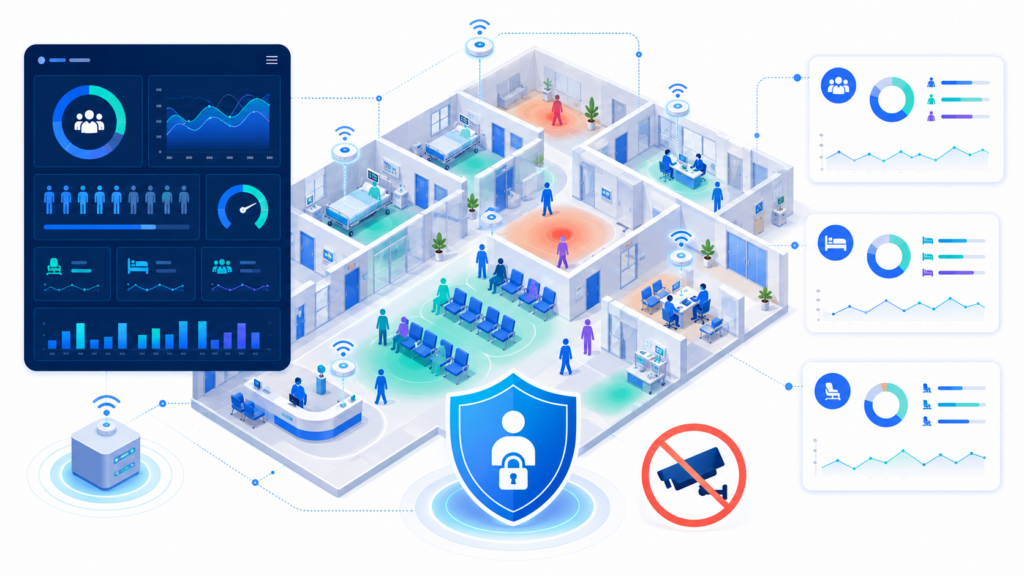
Modern occupancy sensors work on a fundamentally different principle from cameras. Instead of capturing images or video, they measure environmental and physical signals — motion, heat signatures, CO2 levels, humidity, light, and air pressure — to determine whether a space is occupied, how many people are present, and how conditions are changing over time.
This approach is sometimes called presence detection or environmental sensing, and it is becoming standard practice in smart building design globally, including in the UAE’s rapidly evolving healthcare infrastructure.
Real-Time Visibility Across Every Space
A network of smart sensors installed across a hospital floor can provide a live dashboard showing which rooms are occupied, which are vacant, and how long each state has persisted. This data updates continuously — not every 30 minutes when a nurse does a round, but every few seconds.
Facility managers and operations teams can access this information from a central dashboard, a mobile device, or through integration with the hospital’s Building Management System (BMS). Cleaning teams can be notified automatically when a room becomes vacant. HVAC and lighting can be adjusted dynamically based on actual occupancy rather than guesswork.
Privacy-Safe by Design
Because these sensors do not capture images or identifiable personal data, they are inherently compliant with patient privacy expectations. There is no footage to manage, no faces to anonymise, and no risk of inadvertent data capture in sensitive clinical areas. The sensor detects that a space is occupied — it does not record who is there or what they are doing.
This makes sensor-based occupancy monitoring not just technically effective but also ethically and legally straightforward to deploy in a healthcare setting.
Proactive, Data-Driven Operations
The real value of continuous occupancy data is not just knowing what is happening now — it is understanding patterns over time. Which consultation rooms are consistently underutilised? Which waiting areas hit critical capacity between 10am and noon? Where is the bottleneck in patient flow on a Tuesday versus a Thursday?
With several weeks of data, a facility manager can make evidence-based decisions about staffing schedules, room allocation, cleaning rosters, and capital investment. This is a significant shift from operating on instinct and experience alone.
KEY BENEFITS OF SENSOR-BASED OCCUPANCY MONITORING IN HOSPITALS
Improved Patient and Staff Safety
- Immediate alerts when spaces exceed safe capacity thresholds
- Faster identification of unoccupied isolation rooms that need cleaning before reuse
- Detection of CO2 build-up indicating poor ventilation — a critical infection control factor
- Reduced risk of patients being left unnoticed in low-visibility areas
Better Operational Efficiency
- Cleaning teams dispatched on demand rather than fixed schedules
- Room turnaround times reduced by 20–40% in documented deployments
- HVAC and lighting costs reduced by conditioning only occupied spaces
- Staff relieved of manual room-check duties, freeing time for patient care
Cost Savings
Energy savings alone can justify the investment in smart sensors for many UAE hospitals. Air conditioning in an unoccupied room costs the same as in an occupied one when running on a fixed schedule. Sensors that trigger setback modes in empty spaces can reduce HVAC consumption by 15–30% in a well-managed deployment.
Add the reduction in wasted bed-hours, improved staff productivity, and fewer compliance incidents, and the financial case becomes straightforward.
Improved Patient Experience
Patients do not see the sensors — but they feel the difference. Waiting areas that are managed based on real-time data are less likely to become overcrowded. Rooms are cleaned and ready faster. Staff are available when needed rather than tied up on administrative tasks.
In a market where UAE private hospitals compete intensely on patient experience, these operational improvements translate directly into satisfaction scores and loyalty.
Better Environmental Conditions
Many modern occupancy sensors also monitor air quality, temperature, humidity, and CO2 levels. In a hospital environment, this data is not just comfort-related — it is clinically relevant. Elevated CO2 levels in a consultation room indicate inadequate ventilation, which increases infection transmission risk. Sensors can trigger alerts before conditions become problematic.
Enhanced Decision Making
When occupancy data is logged over time, it becomes a strategic asset. Administrators can use it to right-size facilities, justify expansion decisions, negotiate cleaning contracts based on actual utilisation, and demonstrate compliance to accreditation bodies with auditable digital records.
REAL-WORLD USE CASES IN UAE HEALTHCARE FACILITIES
Use Case 1: Emergency Department Patient Flow Management A mid-sized private hospital in Dubai installed occupancy sensors across its emergency department — covering triage bays, treatment rooms, and the waiting area. The system integrated with the nursing station display, showing real-time room status. Within three months, average triage-to-room time dropped by 18 minutes as nurses could immediately see which rooms were genuinely ready for the next patient rather than relying on verbal confirmation.
Use Case 2: Infection Control in Isolation Units During the COVID period and in its aftermath, several UAE hospitals recognised the need for better data on isolation room usage. Sensors installed in these areas provided automatic alerts when rooms were vacated, triggering immediate cleaning notifications. The system also monitored air exchange rates as a proxy for ventilation performance, flagging rooms where conditions fell below protocol thresholds.
Use Case 3: Outpatient Clinic Space Utilisation An outpatient facility managing 12 consultation rooms found that four rooms were consistently underutilised on Wednesday afternoons. Manual logs had never surfaced this pattern clearly. With sensor data, the operations manager could see it unambiguously over a six-week period. Scheduling adjustments freed up those rooms for additional appointments, generating measurable additional revenue with zero capital outlay.
Use Case 4: Staff Rest Room and Prayer Room Monitoring In larger UAE hospitals, staff areas including rest rooms and prayer rooms are often either under-resourced or poorly managed. Occupancy sensors provided anonymous data on peak usage times, allowing facilities teams to adjust cleaning schedules, seating capacity, and even prayer room ventilation accordingly — without any privacy implications for staff.
Use Case 5: Post-Operative Recovery Bay Optimisation A surgical centre tracking its recovery bays found that the average vacancy-to-cleaning-to-ready cycle was 42 minutes based on fixed cleaning schedules. After deploying sensors and switching to demand-based cleaning alerts, the cycle dropped to 27 minutes — a 36% improvement that allowed more procedures to be scheduled per day.
HOW SMARTSENSORS CAN HELP
SmartSensors.ae provides smart sensor solutions designed for the UAE’s built environment — including healthcare facilities where privacy, reliability, and operational integration are non-negotiable.
What SmartSensors solutions include:
- Occupancy monitoring — real-time presence detection across all space types without cameras
- Indoor air quality monitoring — CO2, particulate matter, humidity, and temperature
- Vape and smoke detection — important in patient toilets and staff areas
- Environmental monitoring — heat, air pressure, and comfort conditions
- Privacy-safe monitoring — no cameras, no personal data, no footage management
- Real-time alerts and reporting — dashboards, mobile access, and BMS integration
These solutions are not off-the-shelf products installed and forgotten. They are designed to work within the operational realities of UAE healthcare environments, with local support and the ability to integrate with existing facility management platforms.
If you are a facility manager, operations director, or administrator evaluating your current approach to space management, a conversation with the SmartSensors team is a practical starting point — not a sales call, but a diagnostic discussion about where the gaps are and what a sensor deployment might realistically deliver for your facility.
FREQUENTLY ASKED QUESTIONS
- Do occupancy sensors in hospitals require any installation in patient rooms? Sensors can be mounted discreetly on ceilings or walls, typically taking less than 30 minutes per room to install. They do not require any building work, cabling disruption, or downtime. Most deployments in UAE hospitals are completed over a weekend with no impact on operations.
- Are sensor-based occupancy systems compliant with UAE healthcare privacy regulations? Yes. Because these sensors collect environmental and motion data rather than images or personal identifiers, they fall outside the scope of patient privacy regulations that apply to cameras and video recording. They are also aligned with the UAE Personal Data Protection Law (PDPL) requirements, as no personal data is captured or stored.
- How accurate are occupancy sensors compared to manual room checks? Modern sensors using a combination of passive infrared (PIR), thermal imaging (non-camera based), and CO2 detection achieve accuracy rates of 95%+ in controlled environments. They also provide continuous data, whereas manual checks are inherently point-in-time snapshots.
- Can occupancy sensor data integrate with our existing hospital management systems? Most smart sensor platforms provide API connectivity and can integrate with Building Management Systems, CMMS (Computerised Maintenance Management Systems), and facility dashboards. Integration complexity depends on the existing systems in place, but it is typically achievable in a standard deployment.
- What is the typical return on investment for a hospital occupancy sensor deployment in the UAE? ROI varies depending on facility size and how the data is acted upon. However, most facilities see measurable returns within 12 to 18 months through a combination of energy savings (typically 15–25% on HVAC in monitored areas), improved room turnaround times, and reduced manual labour costs. Some deployments in private hospitals have demonstrated payback in under 12 months.
- Can sensors monitor toilet and prayer room occupancy without violating staff or patient privacy? Yes. Sensors for toilet cubicles and prayer rooms typically detect door status and presence within the cubicle using door contact sensors or infrared presence detectors. No audio or visual data is captured. The system shows only whether the space is occupied or vacant — exactly the information needed to manage cleaning and availability.
- Is sensor-based monitoring suitable for smaller clinics and day surgery centres, not just large hospitals? Absolutely. The scalability of sensor systems means they can be deployed across as few as 5 to 10 rooms in a small outpatient clinic or scaled across a 500-bed hospital. The operational benefits — faster room turnover, demand-based cleaning, real-time visibility — apply regardless of facility size.
- How long does it take to start seeing useful data after sensors are installed? Most facilities begin receiving meaningful occupancy data within 24 to 48 hours of installation. Actionable pattern data — the kind used to adjust schedules, reallocate resources, or identify inefficiencies — typically emerges within two to four weeks of continuous monitoring.
CONCLUSION: BETTER DECISIONS START WITH BETTER DATA
The hospitals that operate most efficiently in the UAE are not necessarily the ones with the newest buildings or the largest budgets. They are the ones that can see clearly what is happening across their facilities in real time — and respond accordingly.
Occupancy monitoring has historically been one of the hardest problems to solve in healthcare operations because the obvious solution (cameras) creates more problems than it solves. Smart sensors offer a genuinely different approach: accurate, continuous, privacy-safe, and actionable.
The technology is not experimental. It is in use in healthcare facilities across the region. The business case is well established. And the operational improvements — faster room turnaround, better staff deployment, reduced energy waste, stronger compliance documentation — are achievable at scale.
The question worth asking today is not whether your facility needs better occupancy data. It almost certainly does. The question is how long it will take to act on that.
SUGGESTED CTAS
- Primary: Book a Free Occupancy Assessment for Your Facility → /contact
- Secondary: Download Our Smart Sensor Deployment Guide for UAE Healthcare (gated lead magnet)
- Tertiary: See How Our Sensors Work — No Cameras, No Compromise → product page