THE COMPLAINT YOU NEVER SEE COMING
A guest checks in after a long international flight. The room looks immaculate — fresh linens, spotless bathroom, city view. But within minutes, there’s a faint stuffiness, an unexplained odour, or a vague sense that the air just feels heavy. They don’t always call the front desk. Instead, they quietly pull out their phone and start writing a review.
Air quality complaints are among the most damaging — and most preventable — issues in hotel operations. Unlike a broken hairdryer or a slow Wi-Fi connection, poor air quality is harder to pin down, harder to fix in the moment, and far more likely to translate into a negative online review. In a market as competitive as the UAE, where hospitality standards are world-class and guests have high expectations, this is a problem that deserves serious operational attention.
This article is written for hotel managers, facility managers, and property operations teams who want to understand the full picture: why air quality issues happen, what they cost, and how modern monitoring technology can help you stay ahead of the problem rather than reacting to it after the damage is done.
UNDERSTANDING THE PROBLEM: WHAT’S ACTUALLY IN THE AIR
When guests complain about air quality, the complaint usually sounds vague — “the room smelled,” “it felt stuffy,” “I had a headache all night.” But behind those vague descriptions is a set of very measurable, very manageable environmental variables.
Common Indoor Air Quality Issues in Hotels
- Carbon dioxide (CO₂) buildup is one of the most overlooked culprits. In a closed room with poor ventilation, CO₂ levels rise naturally from occupants breathing. At elevated concentrations, guests experience fatigue, headaches, and disrupted sleep — symptoms they may not connect to their environment, but will certainly remember.
- Volatile organic compounds (VOCs) are chemical compounds that off-gas from cleaning products, air fresheners, furniture, carpets, and even wall paints. Many hotels — with good intentions — use strong-scented cleaning agents that leave behind chemical residues. The result can feel more like a hospital corridor than a five-star retreat.
- Humidity imbalances are particularly relevant in the UAE climate. When HVAC systems are set incorrectly or are not well maintained, rooms become either too dry (causing discomfort, dry skin, and static electricity) or too humid (which creates a breeding ground for mould and produces musty odours). In a region where outdoor humidity swings significantly between seasons, managing indoor humidity requires consistent monitoring.
- Particulate matter (PM2.5 and PM10) — fine airborne particles from dust, outdoor pollution, or even heavy foot traffic in corridors — can aggravate respiratory conditions. For guests with allergies or asthma, this is not a minor inconvenience; it’s a health issue that can prompt both a formal complaint and a request for a refund.
- Vape and smoke infiltration is an increasingly common problem in UAE hotels. Despite clear policies, guests vape or smoke in rooms, and the particles and odour spread into adjacent rooms, corridors, and HVAC systems. Staff often discover this hours or days later, well after the next guest has already checked in.
Why This Problem Persists
The honest answer is that most hotels are managing air quality reactively. The current industry standard is a periodic check — engineering walks the floor, housekeeping notes obvious smells, and maintenance responds to complaints after they are received. Without continuous monitoring, problems build invisibly. By the time a guest notices something is wrong, the issue may have existed for hours.
There is also a tendency to confuse air quality with cleanliness. A visually spotless room can still have poor air quality. The two are related but distinct, and this misunderstanding leads teams to invest in cleaning processes rather than environmental monitoring.
THE BUSINESS IMPACT: MORE THAN JUST A BAD REVIEW
It is tempting to view air quality complaints as an occasional nuisance — a small percentage of guests who are difficult to please. The financial and operational reality tells a different story.
Reputation and Revenue Loss
In the UAE’s hospitality sector, a hotel’s online rating on platforms like Booking.com, Google, and TripAdvisor is directly tied to occupancy rates and the ability to command premium pricing. A drop from 4.6 to 4.3 stars may seem minor, but it can translate to a meaningful reduction in direct bookings, particularly among high-value corporate and leisure travellers.
A single viral negative review mentioning mould, bad smells, or poor ventilation can influence dozens — sometimes hundreds — of booking decisions. Unlike a service complaint (which guests understand can happen), an environmental complaint signals something systemic. It raises the question: is this a one-off, or is this how the property is maintained?
Staff and Operational Costs
When air quality complaints spike, the operational response is expensive and disruptive. Engineering teams are pulled from scheduled maintenance to investigate root causes. Rooms get taken offline for deep cleaning or HVAC servicing. Housekeeping spends additional time re-treating affected rooms. In a busy period, this creates a domino effect across operations.
There is also the hidden cost of staff wellbeing. Hotel employees spend long hours in the same indoor environments as guests. Poor air quality — particularly high CO₂ levels in back-of-house areas or inadequate ventilation in laundry and kitchen spaces — affects staff concentration, energy levels, and morale, which in turn affects service quality.
Health, Liability, and Compliance
The UAE has clear guidelines under the Dubai Municipality and Abu Dhabi’s relevant health authorities regarding indoor air quality in commercial establishments. As regulatory scrutiny on indoor environments increases across the region, hotels that cannot demonstrate active monitoring and management of air quality face increasing compliance and reputational risk.
For luxury and business hotels catering to international guests, the exposure goes further. Guests who experience health impacts during a stay — particularly those with documented respiratory conditions — can and do pursue formal complaints and compensation claims.
TRADITIONAL APPROACHES AND WHY THEY FALL SHORT
Most hotels currently manage air quality through a combination of scheduled HVAC maintenance, housekeeping protocols, and reactive complaint handling. Each of these has real value — but none of them provides what the problem actually requires: continuous, real-time visibility.
- Scheduled HVAC maintenance is essential but infrequent. An HVAC unit serviced quarterly can develop problems in week two of a new cycle. Filters degrade, dampers stick, airflow becomes uneven — and there is no early warning system to catch these issues before they affect guest experience.
- Housekeeping inspections rely on human senses, which are inconsistent and often unable to detect issues at the threshold where guests begin to notice. A housekeeper who has been working through 30 rooms in a day may not notice a slightly elevated mustiness in room 24. Guests who walk in fresh will.
- Reactive complaint management — responding to guest feedback — is by definition too late. The guest has already had a poor experience. The review may already be written. The best the hotel can do at this point is offer compensation, which does not undo the damage to reputation.
- Air fresheners and chemical masking deserve particular mention because they are widely used and often counterproductive. Covering an odour with a synthetic fragrance does not address the underlying cause. For many guests — particularly those sensitive to chemicals or with allergies — strong air fresheners are themselves a source of discomfort.
HOW SMART SENSORS HELP HOTELS TAKE CONTROL
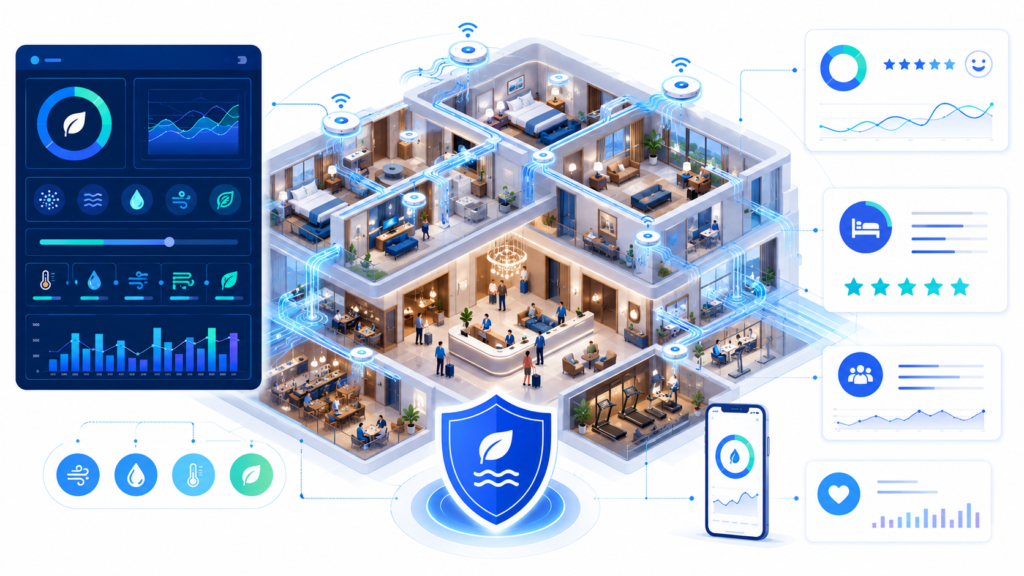
Smart environmental sensors work by continuously measuring the key variables that determine air quality — CO₂, VOCs, humidity, temperature, particulate matter, and in some devices, vape and smoke detection. They do this around the clock, generating real-time data that is accessible from a central dashboard or mobile app.
The shift this represents is from inspection to monitoring, and from reactive to proactive management.
Real-Time Visibility Across the Property
With sensors installed in guest rooms, corridors, conference facilities, and back-of-house areas, operations teams can see — at any moment — where conditions fall outside acceptable ranges. Instead of waiting for a guest to call the front desk, the system alerts relevant staff when a room’s CO₂ level has been elevated for 30 minutes, or when humidity in a corridor has climbed above the recommended threshold.
This changes the entire operational dynamic. Engineering is dispatched to investigate before a guest even notices the issue. Housekeeping can prioritise rooms that genuinely need attention rather than treating every room identically.
Proactive HVAC and Maintenance Management
One of the most practical benefits is the ability to use sensor data to identify HVAC performance issues early. If a room consistently shows poor air quality despite regular maintenance schedules, that is a signal that the unit needs attention. Conversely, if data shows that air quality across a floor consistently improves after HVAC cycles, that validates the maintenance schedule and helps justify the investment in servicing.
Over time, this data builds a clear picture of which rooms or areas are structurally challenging — perhaps due to their position in the building, adjacency to service areas, or HVAC design — and allows management to make targeted improvements.
Vape and Smoke Detection
For hotels struggling with policy compliance, smart sensors that detect vape aerosols and smoke particulates provide an immediate capability that was previously unavailable. When a sensor in a non-smoking room detects vaping, the system can alert security or front desk staff in real time, enabling a timely response that protects the room for the next guest and enforces the hotel’s stated policy.
This is increasingly relevant in the UAE, where hotels are balancing the expectations of diverse international guests with clear property policies and local regulations.
Data-Driven Decision Making
Over weeks and months, the data generated by environmental sensors becomes a valuable operational asset. Managers can identify patterns — which days, which hours, which room types produce the most air quality events — and adjust staffing, maintenance schedules, and HVAC settings accordingly.
This is the difference between managing by intuition and managing by evidence. In a competitive hospitality market, that distinction matters.
KEY BENEFITS FOR HOTEL OPERATIONS
- Improved Guest Safety and Comfort — Continuous monitoring ensures that air quality remains within safe, comfortable ranges — protecting guests with respiratory conditions, allergies, and sensitivities, and reducing the likelihood of health-related incidents during a stay.
- Better Operational Efficiency — Real-time alerts allow engineering and housekeeping teams to respond precisely, avoiding both the cost of over-cleaning rooms that don’t need it and the reputational damage of under-responding to rooms that do.
- Measurable Cost Savings — Early identification of HVAC performance issues prevents expensive emergency repairs. Reduced guest compensation costs, fewer room write-offs for deep cleaning, and lower reactive maintenance call-outs all contribute to a clearer operational budget.
- Stronger Guest Experience and Reviews — Guests who sleep well, breathe comfortably, and never notice the air quality in their room rarely write complaints about it. That silence is enormously valuable. Proactive air quality management is, at its core, a guest experience investment.
- Better Environmental Conditions for Staff — Employees who work in well-ventilated, comfortable environments are more alert, more productive, and less prone to sick days. In a labour-intensive industry like hospitality, this is a meaningful benefit.
- Enhanced Decision Making and Accountability — Sensor data creates an auditable record of environmental conditions across the property. This supports compliance reporting, assists in resolving guest disputes with factual evidence, and provides management with the insight needed to make informed capital investment decisions.
REAL-WORLD USE CASES IN UAE HOTEL OPERATIONS
The Business Hotel with High Corporate Turnover A four-star business hotel in Dubai’s DIFC district was receiving a pattern of complaints from corporate guests — headaches, poor sleep, and a general sense of fatigue after one or two nights. Environmental monitoring revealed that several executive rooms had CO₂ levels that climbed significantly overnight, particularly when the climate control was set to recirculation mode. Adjusting the HVAC settings and adding a monitoring alert threshold resolved the issue. The complaints stopped.
The Resort Property Managing Seasonal Humidity A beach resort in Ras Al Khaimah was experiencing a spike in musty smell complaints during the winter months, when outdoor humidity was highest. Sensors identified that humidity in several ground-floor rooms consistently exceeded recommended indoor levels during overnight hours. Targeted dehumidification adjustments — informed by real data rather than generalised HVAC settings — addressed the problem.
The City Hotel Enforcing No-Smoking Rooms A hotel near Dubai International Airport was repeatedly discovering evidence of smoking in designated non-smoking rooms only during checkout inspections — too late to prevent the problem or respond in time. After installing vape and smoke detection sensors, the front desk received real-time alerts when incidents occurred. The hotel was able to respond during the stay, protect subsequent guests, and enforce its policy consistently.
The Large Conference Hotel Managing Event Spaces A hotel hosting regular large-scale events in its ballroom and meeting rooms was receiving feedback that sessions felt “stuffy” or “uncomfortable” after the first hour. CO₂ monitoring confirmed that occupancy levels were routinely overwhelming the ventilation capacity of the spaces. Adjusting HVAC response protocols for event setups — linked to sensor thresholds rather than fixed timers — significantly improved the feedback from event organisers.
HOW SMARTSENSORS CAN HELP
Modern smart sensors from SmartSensors.ae are specifically designed for commercial and hospitality environments in the UAE, where air quality management needs to account for both the climate and the operational demands of high-occupancy properties.
The Halo sensor range provides:
- Indoor air quality monitoring — continuous measurement of CO₂, VOCs, humidity, temperature, and particulate matter across guest rooms, corridors, and common areas
- Vape and smoke detection — real-time alerts when vaping or smoking is detected in non-smoking spaces, enabling timely response
- Occupancy monitoring — understand how spaces are being used and correlate occupancy patterns with air quality data
- Environmental monitoring — track conditions across multiple floors and zones from a single dashboard
- Privacy-safe monitoring — no cameras or audio recording; sensors measure environmental data only, making them fully appropriate for guest rooms and sensitive areas
- Real-time alerts and reporting — configurable thresholds trigger instant notifications to relevant staff, with full historical reporting for compliance and management review
For hotel operations teams looking to move from reactive complaint management to proactive environmental stewardship, this kind of continuous visibility is the foundation of a credible solution.
FREQUENTLY ASKED QUESTIONS
- Can air quality sensors be installed in guest rooms without compromising guest privacy? Yes. Environmental sensors measure physical variables — CO₂, humidity, particulate matter, and similar parameters — without any audio or video capability. There are no cameras and no recording of any personal data. In the UAE context, this makes them fully appropriate for installation in guest rooms, as they provide environmental data only. SmartSensors’ Halo range is specifically designed with privacy-safe monitoring in mind.
- How quickly can air quality issues be detected and resolved with smart sensors? Most smart sensor platforms generate alerts within minutes of a threshold being exceeded. This means that if CO₂ levels begin to rise in an occupied room, or vape is detected in a non-smoking area, relevant staff can be notified and respond within the same shift — often before the guest becomes aware of a problem.
- Is indoor air quality monitoring a regulatory requirement for hotels in the UAE? The UAE has guidelines on indoor environmental quality under Dubai Municipality and Abu Dhabi health authority frameworks. While mandatory continuous sensor monitoring is not yet universally codified for all hotel categories, the regulatory direction of travel is clear, and several categories of commercial properties already face enhanced scrutiny. Proactive monitoring now positions a property well ahead of evolving requirements.
- How many sensors does a typical hotel need, and where should they be placed? This depends on the property size, room types, and operational priorities. A practical starting point is to cover a representative sample of room categories, key corridors, and high-occupancy common areas such as lobbies, gyms, and conference facilities. A sensor audit — where data from an initial deployment informs wider rollout — is often the most cost-effective approach.
- What is the return on investment for hotel air quality monitoring? ROI comes from several sources: reduction in guest compensation payouts, fewer rooms taken offline for emergency deep cleaning, lower reactive maintenance costs through early HVAC fault detection, improved online review scores (which drive booking conversion and pricing power), and reduced staff sick days. For a mid-size property processing a meaningful volume of reviews, even a modest improvement in ratings score can produce a measurable lift in revenue.
- Can smart sensors integrate with existing hotel management systems? Many smart sensor platforms, including SmartSensors’ Halo range, offer integration capabilities with property management systems and building management systems. This allows air quality data to be incorporated into existing workflows — for example, triggering a maintenance work order automatically when a threshold is exceeded — rather than requiring teams to monitor a separate system.
- How does vape detection work in a hotel setting? Vape detection sensors identify the specific aerosol particles and chemical compounds produced by e-cigarettes and vaping devices. They are calibrated to distinguish vape from other environmental variables, reducing false alerts. When triggered, they send a real-time alert to designated staff — front desk, security, or duty manager — with the specific room or area identified.
- Are smart sensors suitable for outdoor pool areas or spa facilities? Yes, though the specific sensor configuration varies by environment. Spa areas often benefit most from humidity and VOC monitoring; pool areas may require different parameters. A site assessment helps identify the right sensor type for each zone within a property.
CONCLUSION: THE INVISIBLE AMENITY
Guests will not write reviews praising the CO₂ levels in their room. They will not notice when humidity stays exactly where it should, or when a potential smoke incident was resolved before they were even aware of it. That is exactly the point.
Air quality management, when done well, is invisible. The guest simply feels comfortable, sleeps well, and wakes up refreshed. They give the property five stars and book again. The business outcome is real and measurable, even when the mechanism is silent.
For hotel managers and facility teams in the UAE, the question is not whether air quality monitoring is worth investing in — it is whether the cost of not monitoring, in guest complaints, damaged reviews, and reactive operational spend, is something the property can continue to absorb.
The technology to manage this proactively exists today, it is cost-effective at scale, and it is designed for exactly the kind of high-occupancy, high-expectation environments that define UAE hospitality.
Take a practical first step: walk your property today and ask where you genuinely know what the air quality is, in real time, and where you are simply assuming it is acceptable. That gap is where monitoring delivers its value.
SEO NOTES AND TECHNICAL APPENDIX
Primary Keyword
- Hotel air quality complaints UAE
Secondary Keywords
- Indoor air quality monitoring hotel
- Smart sensors for hotels UAE
- Vape detection hotel rooms
- HVAC management hotel
- Guest complaints air quality
- Hotel environmental monitoring
- CO2 monitoring hotel rooms
- Smart building technology hospitality UAE
SUGGESTED INTERNAL LINKING OPPORTUNITIES
- Link to SmartSensors product page: Halo sensor range
- Link to SmartSensors use case page: Hospitality / Hotels
- Link to related article: “What is Indoor Air Quality and Why It Matters for Commercial Buildings”
- Link to related article: “How Smart Building Sensors Reduce Facility Operating Costs”
- Link to contact/demo page: “Book a Free Site Assessment”
SUGGESTED CTA
- Primary CTA: “Book a Free Site Assessment — Find Out What’s Happening to the Air Quality in Your Property”
- Secondary CTA: “Download Our Indoor Air Quality Guide for UAE Hospitality Teams”
- In-article CTA placement: After the “How SmartSensors Can Help” section and again at the end of the article.
Article prepared for SmartSensors.ae — targeting facility managers, hotel operations teams, and property decision-makers in the UAE market.