It’s 1 AM on a Thursday night at a popular nightclub in Dubai Marina. The dance floor is packed, the bass is thumping, and somewhere in the VIP restroom, a small group of guests has gathered for far longer than a bathroom visit usually takes. The duty manager has no idea — until a complaint comes in an hour later about the smell of smoke, or worse, until a guest is found unwell in a stall that nobody checked.
This scenario plays out across nightclubs, lounges, and late-night venues throughout the UAE more often than most operators would like to admit. And the instinctive response from many venue owners is the same: add more cameras.
But here’s the uncomfortable truth — cameras can’t go everywhere. Restrooms, private booths, VIP cabins, and smoking areas are exactly the spaces where incidents tend to happen, and they’re also exactly the spaces where CCTV is either legally restricted or simply inappropriate from a guest privacy standpoint.
This creates a real operational gap. Nightclub safety isn’t just about watching people — it’s about understanding what’s happening in your venue in real time, including in the blind spots that cameras were never meant to cover. For facility managers, operations managers, and security teams running entertainment venues in Dubai, Abu Dhabi, and across the Emirates, this gap has financial, legal, and reputational consequences that are easy to underestimate.
This article looks at why “more cameras” is often the wrong answer, what’s really driving safety and compliance risks inside nightlife venues, and how a newer category of smart environmental sensors is helping UAE operators close these gaps quietly, effectively, and without compromising guest privacy.
Understanding the Problem: Blind Spots in Nightclub Safety
Every nightclub operator knows their venue has blind spots. The question is whether they know how big those blind spots actually are.
Where the Real Risks Are Hiding
Most safety incidents and rule violations in nightlife venues don’t happen on the dance floor in plain view of staff and cameras. They happen in:
- Restrooms and washroom cubicles — a common location for vaping, smoking, and drug use, as well as a place where guests can become unwell unnoticed
- VIP rooms and private booths — spaces deliberately designed for privacy, which also makes them attractive for rule-breaking
- Smoking terraces and outdoor lounges — often poorly monitored once the venue gets busy
- Storage rooms, staff corridors, and back-of-house areas — overlooked because they’re “not guest-facing,” yet still pose fire, overcrowding, and safety risks
Why This Problem Persists
The honest answer is that most venues are operating reactively. Staff are stretched thin during peak hours, security teams are focused on entry points and the main floor, and nobody has the bandwidth to physically check every restroom stall or VIP cabin every fifteen minutes.
Add to this a few UAE-specific realities:
- Many nightclub layouts include multiple private or semi-private zones by design — bottle service areas, shisha lounges, and VIP sections are a core part of the business model
- Dubai’s strict no-smoking and no-vaping regulations in enclosed public spaces mean operators carry direct legal exposure for violations they may not even be aware of
- High guest turnover during peak nights (Thursday to Saturday especially) means incidents can go unnoticed for hours
The result? Many operators are essentially “flying blind” in the parts of their venue where risk concentrates the most — and adding another camera to the main bar area does nothing to fix that.
Impact on Businesses: What’s Really at Stake
It’s tempting to file this under “just part of running a nightclub.” But the impact goes well beyond an occasional awkward incident.
Financial Impact
- Fines for smoking and vaping violations in enclosed venues can be significant in the UAE, and repeated violations can affect licensing renewals
- Liability costs if a guest is injured or becomes seriously unwell in an unmonitored area and the venue cannot demonstrate reasonable duty of care
- Insurance implications — venues with poor incident documentation often face higher premiums or claim disputes
- Lost revenue from temporary closures if a venue is found in breach of health, safety, or licensing conditions during an inspection
Operational Impact
- Security and housekeeping staff spend disproportionate time on manual restroom and zone checks, pulling them away from areas that need active attention
- Incident response is slow because staff only discover problems after a guest complaint, not in real time
- Maintenance issues (overcrowded restrooms, poor ventilation, AC not coping with a packed VIP room) often go unnoticed until guests start complaining
Customer and Employee Impact
- Guests who encounter unpleasant restroom conditions — poor air quality, lingering smoke smell, overcrowding — form a lasting negative impression of the venue, regardless of how good the music or service was
- Staff working in poorly ventilated VIP rooms or smoking areas for long shifts are exposed to air quality conditions that affect their wellbeing
- Repeat incidents in the same area (say, a particular restroom known for vaping) can create a culture where staff feel safety policies aren’t being enforced
Compliance and Risk
UAE authorities, particularly in Dubai, have been tightening enforcement around smoking and vaping in enclosed public spaces, occupancy limits, and fire safety compliance for entertainment venues. Operators who cannot show they have reasonable monitoring systems in place — especially in areas where cameras can’t be installed — are exposed during inspections, audits, and after-incident investigations.
Traditional Approaches and Their Limitations
Faced with these risks, most venues lean on a familiar toolkit. Here’s where each one falls short.
More CCTV Cameras
The default instinct. But cameras have hard limits in nightlife venues:
- Restrooms and private cabins are off-limits for cameras in almost all jurisdictions, including the UAE, due to privacy laws
- Even where cameras are allowed (corridors, entrances, main floor), adding more of them increases the monitoring burden on security staff who are already watching dozens of feeds
- Cameras tell you what happened, but rarely what’s about to happen — they’re a record, not an early warning system
Manual Patrols and Spot Checks
Security or housekeeping staff doing rounds every 20–30 minutes sounds reasonable, but in practice:
- A vaping incident, an overcrowded VIP room, or someone unwell in a stall can occur and resolve (or worsen) well within that window
- Patrols are predictable — and predictable patrols are easy for guests intent on rule-breaking to work around
- During peak hours, the same staff doing patrols are also needed for crowd management, leading to gaps
Relying on Guest or Staff Complaints
This is essentially a “wait and see” approach. By the time a complaint reaches management, the smoke has cleared, the overcrowded room has emptied out, or the unwell guest has already left — and the venue has no record to act on or learn from.
Stronger Signage and Policy Enforcement
Signage reminding guests not to smoke or vape indoors is necessary, but signage alone doesn’t change behavior in private spaces where guests assume no one is watching — and where, often, no one is.
How Smart Sensors Help
This is where a different approach comes in — one that doesn’t rely on watching people, but on understanding the environment itself.
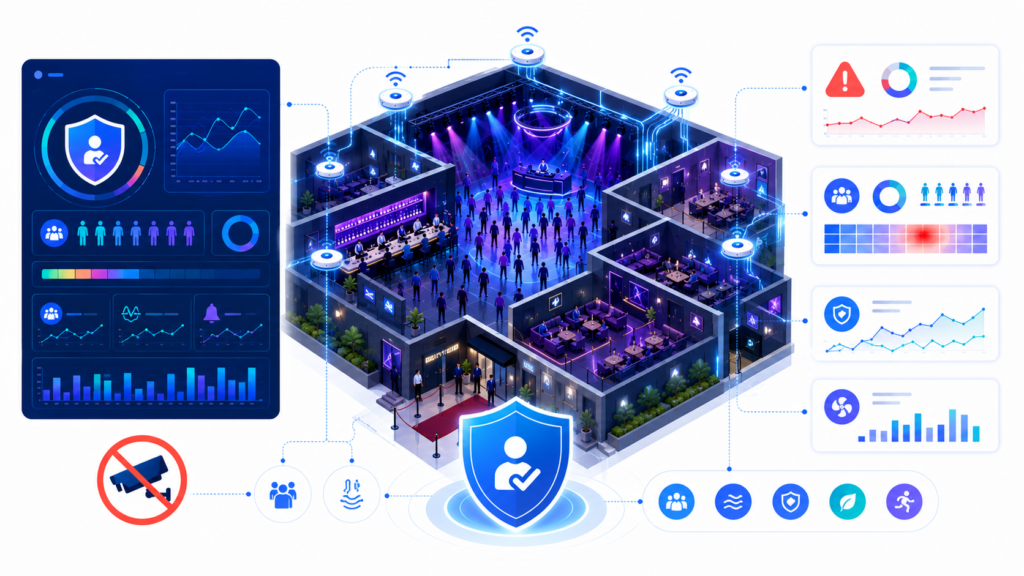
Smart environmental sensors, like Halo sensors, are compact devices installed discreetly in ceilings or walls. Rather than capturing images or video, they continuously monitor conditions in the space — things like air quality, vape and smoke particles, occupancy levels, noise levels, and even signs of aggressive sound patterns associated with altercations.
Real-Time Visibility Without Cameras
Because these sensors don’t record video or audio conversations, they can be installed in restrooms, VIP cabins, and private lounges — exactly the blind spots where cameras can’t go. The moment vape or smoke particles are detected in a restroom, or a room becomes overcrowded beyond its safe capacity, the system sends an instant alert to the relevant staff member’s phone or the security desk.
Proactive Management Instead of Reactive Response
Instead of discovering a problem after a guest complains, your team gets a notification while the situation is still developing. A security staff member can walk over, check in, and address it calmly — often before it escalates into something bigger.
Data-Driven Decision Making
Over time, these sensors build a picture of your venue that’s genuinely useful for management decisions:
- Which restroom consistently shows vaping activity on Friday and Saturday nights — and might need a staff presence during peak hours
- Which VIP room regularly runs hotter or has poorer air circulation than others — useful for facilities and HVAC planning
- Occupancy patterns across the night that help with staffing and crowd management decisions
This isn’t about surveillance — it’s about giving operators the operational visibility that cameras were never able to provide in these spaces in the first place.
Key Benefits for Nightclub Operators
Improved Safety Early detection of overcrowding, vaping/smoking, or unusual sound patterns means staff can respond while a situation is still manageable — reducing the chance of incidents escalating unnoticed in private areas.
Better Operational Efficiency Security and housekeeping teams stop doing blind, time-consuming patrols and instead respond to specific alerts, freeing them up for guest-facing duties during your busiest hours.
Cost Savings Reduced exposure to smoking/vaping fines, fewer liability incidents from unmonitored areas, and better-informed maintenance decisions (e.g., HVAC servicing based on actual air quality data rather than guesswork) all contribute to lower long-term costs.
Improved Customer Experience Guests notice when restrooms are well-ventilated, VIP rooms aren’t overcrowded or stuffy, and the overall environment feels comfortable — even if they never know why.
Better Environmental Conditions Continuous air quality monitoring across restrooms, VIP areas, and smoking zones helps maintain a more comfortable environment for both guests and staff working long shifts.
Enhanced Decision Making Management gets objective, ongoing data about how different zones of the venue actually perform on busy nights — informed by facts, not assumptions or isolated complaints.
Real-World Use Cases for UAE Nightlife Venues
1. The VIP Restroom Vaping Pattern A Dubai nightclub installs sensors in its VIP restroom after repeated complaints about a lingering vape smell. Within the first two weekends, the system flags vape detection alerts consistently between 12:30 AM and 2 AM on Fridays and Saturdays. Management adjusts staffing to have an attendant present during that window — and the smell complaints stop.
2. Avoiding an Overcrowding Citation A rooftop lounge in Abu Dhabi uses occupancy sensors in its enclosed VIP cabins. During a particularly busy event, one cabin approaches its safe occupancy limit well before staff would have noticed visually. An alert prompts the floor manager to politely manage the crowd before it becomes a fire-safety or licensing issue during a routine inspection.
3. Air Quality in the Smoking Lounge A venue with an indoor shisha and smoking lounge monitors air quality levels throughout the night. When particulate levels spike beyond expected ranges — suggesting the ventilation system isn’t keeping pace with occupancy — facilities is alerted to check the HVAC, rather than guests simply enduring poor air quality for the rest of the night.
4. Late-Night Wellness Check A guest spends an unusually long time alone in a restroom stall. While sensors don’t identify individuals, occupancy duration data combined with air quality readings (no smoke, but extended occupancy) prompts a staff member to do a discreet welfare check — addressing a potential medical situation faster than a complaint-based system ever could.
Frequently Asked Questions
Q1: Do smart sensors record video or audio of guests? No. Sensors like Halo monitor environmental conditions — such as air quality, vape particles, occupancy, and ambient sound levels — without recording video or capturing conversations, making them suitable for restrooms and private areas.
Q2: Can these sensors detect vaping even if someone tries to hide it? Yes. The sensors detect changes in air particles associated with vape aerosol, regardless of where in the room someone is standing, making it difficult to avoid detection simply by going to a corner or a stall.
Q3: Are these sensors legal to install in nightclub restrooms in the UAE? Because they don’t capture images, video, or recognizable audio, environmental sensors generally fall outside the privacy restrictions that apply to cameras and audio recording devices. Venues should still confirm placement with their legal or compliance advisor as part of standard practice.
Q4: How quickly do staff get notified of an issue? Alerts are typically sent in real time — within seconds of a threshold being crossed — to a designated staff member’s device or a central security dashboard, depending on how the system is configured.
Q5: Will this replace the need for security staff or cameras altogether? No. Smart sensors are designed to complement existing security measures by covering the areas cameras can’t reach, giving staff better information to act on — not to replace human judgment or existing camera coverage in public areas.
Q6: Can sensors help during licensing inspections or audits? Yes. Many venues use historical sensor data and alert logs as part of demonstrating due diligence around smoking policy enforcement and occupancy management during compliance reviews.
Q7: How long does installation take for a typical nightclub? Installation time varies by venue size and the number of zones being monitored, but sensors are generally compact, wireless, and designed for discreet placement without major renovation work.
Q8: Can the system distinguish between different types of alerts, like vaping vs. overcrowding vs. unusual noise? Yes. Each sensor type monitors specific conditions, and alerts are categorized accordingly, so staff know immediately what kind of situation they’re responding to.
How SmartSensors Can Help
For nightclub operators in the UAE, the goal isn’t more surveillance — it’s better visibility into the parts of your venue that matter most for safety, compliance, and guest experience, without compromising privacy in sensitive areas.
SmartSensors.ae offers a range of smart environmental sensors designed for venues like yours, covering:
- Indoor air quality monitoring — track ventilation performance in restrooms, VIP rooms, and smoking areas
- Occupancy monitoring — understand real-time crowd levels in enclosed spaces and private cabins
- Vape detection — identify vaping activity in restrooms and private areas where cameras can’t go
- Environmental monitoring — temperature, humidity, and air quality trends across different zones
- Privacy-safe monitoring — designed specifically for sensitive areas like restrooms and VIP rooms, without video or audio recording
- Real-time alerts and reporting — instant notifications to staff, plus historical data for management review and compliance documentation
These tools are designed to work alongside your existing security setup — filling the gaps that cameras simply can’t, and giving your team the information they need to act before a small issue becomes a bigger one.
Conclusion
Nightclub safety in 2026 isn’t about choosing between “more cameras” or “no cameras” — it’s about recognizing that cameras were never designed to cover every space that matters. Restrooms, VIP cabins, and private lounges are where many of the real risks live, and they’re spaces that demand a different kind of monitoring altogether.
For facility managers, operations teams, and venue owners across the UAE, the question worth asking isn’t “do we need more cameras?” but rather: “Do we actually know what’s happening in the parts of our venue we can’t see?”
Taking stock of your venue’s blind spots — and considering how smart environmental sensors might fill them — is a practical first step toward a safer, more compliant, and more comfortable venue for both guests and staff.
Suggested CTA: “Curious about the blind spots in your venue? [Contact SmartSensors.ae] for a no-obligation consultation on smart sensor placement for nightlife and hospitality venues across the UAE.”
SEO & Schema Notes
Primary Keyword: nightclub safety UAE / nightclub safety without cameras Secondary Keywords: vape detection nightclub, smart sensors nightlife venues, occupancy monitoring UAE, air quality monitoring nightclub, privacy-safe monitoring restrooms, Halo sensors UAE
Suggested Internal Linking Opportunities:
- Link “Halo sensors” → SmartSensors.ae product page for Halo sensors
- Link “vape detection” → dedicated Vape Detection solutions page
- Link “occupancy monitoring” → Occupancy Monitoring solutions page
- Link “indoor air quality monitoring” → Air Quality Monitoring solutions page
- Link “Dubai’s strict no-smoking and no-vaping regulations” → blog post on UAE smoking/vaping compliance (if available)
- Link “Contact SmartSensors.ae” → Contact/Consultation request page
FAQ Schema (5 questions for structured data):
- Q: Do smart sensors record video or audio of guests? A: No. Sensors like Halo monitor environmental conditions such as air quality, vape particles, occupancy, and ambient sound levels without recording video or capturing conversations, making them suitable for restrooms and private areas.
- Q: Can these sensors detect vaping even if someone tries to hide it? A: Yes. The sensors detect changes in air particles associated with vape aerosol regardless of where in the room someone is standing, making it difficult to avoid detection.
- Q: Are these sensors legal to install in nightclub restrooms in the UAE? A: Since they don’t capture images, video, or recognizable audio, environmental sensors generally fall outside privacy restrictions that apply to cameras and audio recording devices, though venues should confirm placement with their compliance advisor.
- Q: How quickly do staff get notified of an issue? A: Alerts are typically sent in real time, within seconds of a threshold being crossed, to a designated staff member’s device or a central security dashboard.
- Q: Will this replace the need for security staff or cameras altogether? A: No. Smart sensors complement existing security measures by covering areas cameras can’t reach, giving staff better information without replacing human judgment or existing camera coverage.