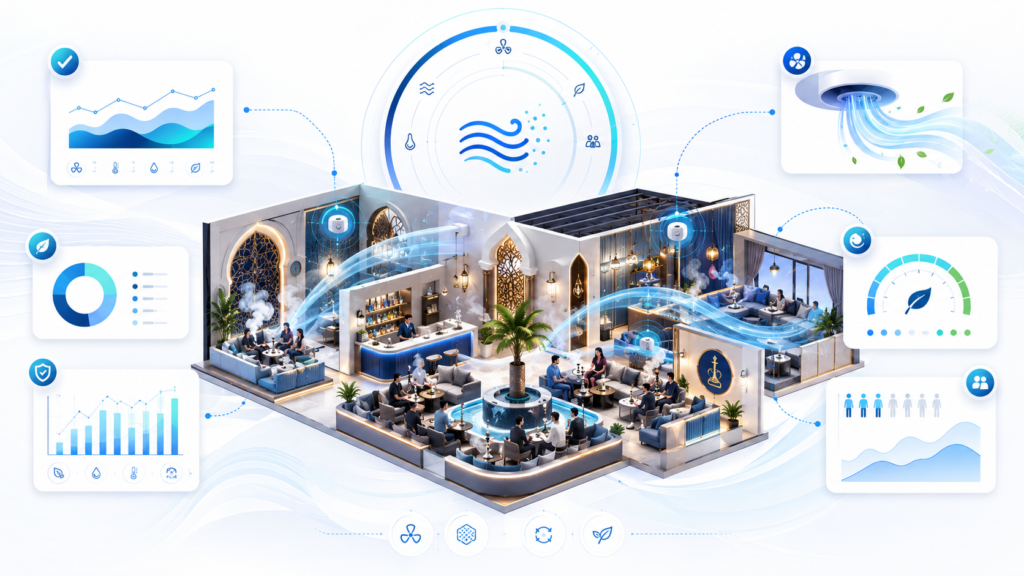
Every shisha cafe owner in the UAE has had this moment: a regular customer walks in, takes one look around at how full the place is, and decides to come back another time. Or a group settles in, orders their pipes, and within 40 minutes asks to move to the outdoor terrace—or leaves altogether. Nothing was technically “wrong.” The service was good, the menu was solid, the music was right. But the air inside just felt too heavy.
For an industry built almost entirely around atmosphere, this is a problem that’s easy to underestimate and expensive to ignore. Indoor air quality in shisha cafes isn’t just a health and safety checkbox—it directly shapes how long guests stay, how much they spend, how often they return, and how comfortable staff feel during long shifts. It also increasingly intersects with UAE health and safety expectations, particularly for cafes operating within malls, hotels, and mixed-use buildings where air quality in one zone can affect neighboring tenants.
The good news is that this is a manageable problem—but only if it’s approached with the right information. Many shisha cafe operators are still managing air quality the same way they did a decade ago: extraction fans, occasional manual checks, and a general sense of “it feels okay in here.” As guest expectations rise and competition in the UAE’s F&B sector intensifies, that approach is starting to show its limits.
This article walks through practical best practices for managing indoor air quality in shisha cafes, the common pitfalls operators run into, and how modern monitoring tools are helping venues move from guesswork to genuine control over their indoor environment.
Understanding the Problem
Why Shisha Cafes Face a Unique Air Quality Challenge
Shisha cafes operate with a continuous, predictable source of smoke and airborne particles—charcoal-heated shisha pipes, often multiple per table, running for extended sessions throughout the evening. Unlike a kitchen exhaust that activates during cooking and then settles, shisha smoke generation is sustained for hours, especially during peak periods like weekend evenings, Ramadan night gatherings, or major sporting events shown on screens.
Several factors make indoor air quality particularly difficult to manage in this setting:
- Charcoal as a heat source – even high-quality natural charcoal produces carbon monoxide and fine particulate matter (PM2.5) as it burns, regardless of the tobacco flavor on top
- Table density – many cafes maximize seating capacity, which means more active pipes per square meter than the ventilation system may have been designed for
- Indoor-outdoor layout transitions – cafes with both indoor seating and covered outdoor terraces often see smoke drift between zones depending on door usage, AC airflow, and wind direction
- Extended operating hours – many shisha cafes operate late into the night, meaning ventilation systems run for long, continuous stretches without a natural reset period
Why It’s Difficult to Get Right
The honest answer is that most cafe operators are working without data. Ventilation systems are typically installed once, based on the floor plan at the time, and rarely reassessed as seating layouts change, new sections are added, or customer volumes grow. Staff become accustomed to the environment over a shift and lose the ability to judge whether air quality is genuinely deteriorating or just feels “normal” for a busy night.
Without an objective way to measure what’s happening in the air, operators are left choosing between two imperfect options: run ventilation at maximum all the time (driving up energy costs) or rely on staff judgment and guest feedback (which means problems are identified after they’ve already affected the experience).
Impact on Businesses
Financial Impact
Ventilation in shisha cafes often represents one of the largest ongoing utility costs in the business, particularly for venues running extraction and AC systems continuously during long operating hours. When systems are run at maximum as a precaution—rather than based on actual need—operators end up paying for capacity they may not require during quieter periods, while still potentially falling short during peak hours.
Operational Impact
Smoke residue affects more than air quality—it settles on curtains, cushions, carpets, and wall fixtures, accelerating wear and increasing the frequency of deep cleaning and replacement. For cafes with a consistent design aesthetic (a key part of the brand experience in competitive markets like JBR, Al Seef, or Yas Island), this can become a recurring cost that’s easy to overlook until furnishings start looking tired faster than expected.
Customer and Employee Impact
Guest tolerance for smoke varies, but there’s a clear line between “atmospheric” and “uncomfortable.” When that line is crossed, the impact shows up in shorter visit durations, lower spend per table, and guests gravitating toward outdoor seating even when it’s not their preference—reducing indoor table turnover. For staff working multiple shifts per week in these environments, sustained exposure to poor air quality is increasingly a workplace wellbeing consideration, especially as UAE labor practices place greater focus on working conditions.
Compliance and Risk Implications
Shisha cafes in the UAE operate under specific guidelines from local municipalities regarding ventilation and air quality, and cafes located within larger buildings—malls, hotels, mixed-use towers—often need to demonstrate that their operations don’t compromise air quality in adjacent non-smoking areas. Being able to show objective air quality data, rather than relying on “it’s always been fine,” is increasingly relevant when these conversations come up with building management or regulatory bodies.
Traditional Approaches and Their Limitations
Common Methods Currently in Use
Fixed extraction settings. Ventilation systems set to run at a constant rate, often unchanged since installation, regardless of how busy the cafe is on any given night.
Visual and smell-based checks. Managers or staff periodically assess the room by eye and nose—a method that’s inherently subjective and affected by how long someone has already been in the space.
Reactive adjustments. Increasing extraction or opening doors/windows only after staff notice the room feels heavy, or after a guest comments on it.
End-of-night assumptions. Reviewing how busy a night was and assuming air quality “must have been fine” if there were no complaints—without any actual measurement to confirm this.
Why These Fall Short
None of these methods provide continuous, objective information. They rely on human perception, which adapts to gradual changes, and on guest feedback, which only surfaces after the experience has already been affected. Most importantly, none of these approaches help operators understand patterns—which nights, times, or zones consistently run into air quality issues—information that’s essential for making informed improvements to ventilation, layout, or operating procedures.
How Smart Sensors Help
Continuous, Objective Air Quality Monitoring
Smart environmental sensors, such as Halo sensors, can be installed across different zones of a shisha cafe to continuously track particulate matter (PM2.5), carbon monoxide, temperature, and humidity. This replaces subjective “it feels fine” assessments with actual readings that reflect real conditions at any given moment.
Real-Time Visibility Across Different Zones
A shisha cafe’s air quality rarely behaves uniformly. The section near the entrance, the indoor seating closest to the kitchen, the covered terrace, and the back corner near the restrooms can all have different conditions depending on layout, airflow, and how tables are arranged. Zone-based sensor placement gives operators a clear picture of where conditions are best—and where they tend to fall short.
Proactive Management Based on Real Conditions
Instead of running ventilation at a fixed rate regardless of demand, sensor data allows extraction to be adjusted based on actual particulate and CO2 levels. If a particular zone shows rising particulate levels during a busy Thursday night, staff can be alerted to increase ventilation in that area specifically—or to manage seating density—before guests notice anything is off.
Data-Driven Decision Making Over Time
With continuous data, patterns emerge: certain nights of the week consistently run higher, certain tables or zones underperform regardless of occupancy, or outdoor terrace conditions shift noticeably with seasonal weather changes. This kind of insight helps operators make targeted decisions—whether that’s adjusting table layouts, upgrading specific extraction points, or rethinking how indoor and outdoor sections are used during different seasons.
Key Benefits
Improved Safety Ongoing monitoring of carbon monoxide and particulate levels helps keep conditions within safe ranges for both guests during their visit and staff working extended shifts.
Better Operational Efficiency Ventilation can be matched to actual occupancy and air quality conditions rather than running at a fixed rate around the clock, reducing unnecessary strain on HVAC systems.
Cost Savings More targeted ventilation management can reduce energy costs during quieter periods, while early identification of underperforming zones can prevent the need for larger, more costly system overhauls down the line.
Improved Customer Experience Guests can enjoy longer, more comfortable visits—supporting higher spend per table and better repeat visit rates, particularly important in a market where shisha cafes compete heavily on atmosphere.
Better Environmental Conditions Consistent monitoring helps maintain a more even balance across different zones, reducing the “lottery” effect where some tables have a noticeably better experience than others on the same night.
Enhanced Decision Making Historical data supports practical decisions—from ventilation upgrades to seating layout adjustments—based on evidence specific to the venue rather than general industry assumptions.
Real-World Use Cases
Standalone Shisha Cafes: A popular cafe in Al Barsha identifies through sensor data that its busiest indoor section consistently runs higher on particulate levels every Thursday and Friday night, prompting a review of extraction capacity specifically for that zone rather than the whole venue.
Hotel-Affiliated Shisha Lounges: A hotel in Downtown Dubai with an outdoor shisha terrace adjacent to its main restaurant uses sensors to monitor whether smoke drifts toward the restaurant entrance during certain wind conditions, allowing staff to adjust seating arrangements on affected evenings.
Mall-Based Shisha Cafes: A cafe operating within a large retail and entertainment complex in Sharjah uses air quality data to demonstrate to mall management that its ventilation system maintains acceptable conditions, supporting ongoing lease and operational discussions.
Multi-Section Cafes: A large shisha cafe in Al Seef with separate indoor, covered terrace, and open-air sections uses sensors across all three to understand how each performs differently throughout the evening, leading to adjustments in which sections are prioritized for new bookings during peak hours.
Frequently Asked Questions
1. Is it realistic to improve air quality without changing what makes shisha cafes appealing? Yes. The goal is to ensure ventilation matches actual demand, not to reduce smoke output itself. Guests still get the atmosphere they expect, while conditions stay within comfortable and safe ranges.
2. What does air quality monitoring actually measure in a shisha cafe? Typically particulate matter (PM2.5), carbon monoxide, temperature, and humidity—giving a clear, ongoing picture of conditions throughout the venue.
3. Can this help reduce energy costs? Yes. Understanding actual conditions allows ventilation systems to run based on real need rather than fixed settings, which can reduce unnecessary energy use during quieter periods.
4. Do different sections of a cafe really have different air quality? In most cases, yes. Layout, table density, proximity to entrances or kitchens, and airflow patterns all affect how air quality varies across a venue—something that’s only visible with zone-based monitoring.
5. How does this support conversations with building management or authorities? Continuous air quality data provides an objective record of conditions, which can be useful when discussing ventilation performance with mall management, landlords, or relevant municipal departments.
6. Will sensors be noticeable to guests? No. Environmental sensors are compact, don’t capture images or audio, and are designed to fit discreetly into a venue’s existing decor.
7. How quickly can operators expect useful insights? Many operators start noticing clear patterns—such as which zones or nights consistently run higher—within the first few weeks of monitoring.
8. Does this apply to outdoor and semi-covered terraces as well? Yes. Sensors can be placed in covered outdoor areas too, which is particularly relevant given how much UAE shisha cafes rely on terrace seating, especially during cooler months.
Conclusion
Indoor air quality is one of the few aspects of a shisha cafe’s operation that directly touches guest experience, staff wellbeing, operating costs, and compliance—all at once. Yet for many UAE operators, it remains one of the least measured. The shift from “it feels fine” to “here’s what’s actually happening in the air” doesn’t require changing what makes a shisha cafe successful. It simply means having the information needed to manage ventilation, layout, and operations with more confidence.
A useful starting point for any operator is a simple question: if asked right now how air quality varies across different sections of your cafe at peak times, would you have an answer—or would it be a guess?
How SmartSensors Can Help
smartsensors.ae works with UAE shisha cafes and hospitality venues to bring practical environmental monitoring into spaces where atmosphere matters most. Our Halo smart sensor solutions can provide:
- Indoor air quality monitoring – continuous tracking of particulate matter, carbon monoxide, and related indicators across different zones
- Occupancy monitoring – understanding how seating density relates to air quality throughout the venue
- Vape detection – useful for mixed-use venues where vaping and shisha policies differ by area
- Environmental monitoring – temperature and humidity tracking to support overall comfort
- Privacy-safe monitoring in sensitive areas – for restrooms or private seating areas within the same venue
- Real-time alerts and reporting – giving operators the information needed to manage ventilation proactively rather than reactively
If your cafe is looking to better understand how air quality varies across your space—without changing the atmosphere your guests come for—our team can talk through how monitoring might apply to your specific layout.