Walk into any popular shisha lounge in Dubai, Abu Dhabi, or Sharjah on a Thursday evening, and you’ll find a familiar scene: cushioned seating, the aroma of flavored tobacco, groups of friends gathered around low tables, and a haze that seems to hang permanently in the air. For many venues, this is simply part of the atmosphere—and part of the business model
But behind that ambiance lies a genuine operational challenge. Shisha lounges, by their very nature, generate significant smoke and airborne particles in enclosed or semi-enclosed spaces. Managing the air quality in these environments isn’t just about guest comfort—it touches on staff health and safety, compliance with UAE health and safety regulations, ventilation system performance, and ultimately, the long-term sustainability of the venue itself.
For facility managers and operators running shisha lounges as part of hotels, restaurants, or standalone venues, air quality is often treated as a fixed cost of doing business—something to be managed with extraction fans and hope. But as regulations evolve and guest expectations shift, particularly among health-conscious younger demographics and international visitors, air quality is becoming a factor that directly affects reputation, staff retention, and operational risk.
This article looks at what’s really happening in the air inside shisha lounges, why it’s harder to manage than most operators realize, and how modern monitoring approaches are helping venues get ahead of the issue—rather than reacting to it.
Understanding the Problem
What Makes Shisha Lounge Air Quality Different
Unlike a typical restaurant or retail space, shisha lounges are designed around an activity that continuously introduces smoke, charcoal combustion byproducts, and flavored tobacco particles into the air. A single shisha session can run for an hour or more, with multiple pipes often active simultaneously across a venue. This creates a sustained source of airborne particulates, carbon monoxide, and fine particulate matter (PM2.5)—particles small enough to penetrate deep into the lungs.
Common contributors to poor air quality in these spaces include:
- Charcoal combustion – traditional charcoal used to heat shisha bowls produces carbon monoxide and fine particulates, regardless of the tobacco flavor used
- High occupancy density – shisha lounges often pack more seating into a given area than standard dining venues, increasing the concentration of smoke per square meter
- Limited or aging ventilation systems – many venues, particularly those operating in converted spaces or older buildings, rely on extraction systems that were never designed for this level of continuous smoke output
- Semi-enclosed outdoor areas – terraces and outdoor seating areas with partial covering can trap smoke depending on wind direction and seasonal conditions, especially during the UAE’s milder winter months when outdoor seating is at its busiest
Why This Is Hard to Solve
The core difficulty is that shisha is the product. Operators can’t simply reduce smoke output without changing the fundamental guest experience they’re selling. This means the solution has to focus on managing air quality around the activity—through ventilation, layout, and monitoring—rather than eliminating the source.
Many venues also lack any objective way to measure what’s actually happening in their air. Staff get used to the smell and haze over a shift, making it difficult to notice gradual degradation. Without data, operators are left guessing whether their ventilation system is actually keeping pace with demand—until something goes wrong, whether that’s a complaint, a health inspection, or a staff member raising concerns about working conditions.
Impact on Businesses
Financial Impact
Ventilation systems in shisha lounges typically run for extended hours and at higher capacity than standard HVAC setups, leading to higher energy consumption. When systems are undersized or poorly maintained, operators often respond by running extraction at maximum continuously—driving up utility costs without necessarily solving the underlying air quality issue. On the other end, oversized or excessive ventilation in cooler months can lead to significant cooling loss and wasted energy.
Operational Impact
Poor air quality can accelerate wear on furnishings, soft furniture, carpets, and curtains, as smoke residue settles into fabrics over time—leading to more frequent replacement or deep-cleaning cycles. It can also affect the comfort of staff working extended shifts in these environments, an increasingly important consideration as UAE labor regulations place greater emphasis on workplace conditions.
Customer Experience Impact
While shisha guests expect some smoke, there’s a difference between ambiance and an environment that feels genuinely uncomfortable—eyes stinging, throats irritated, or a heaviness in the air that makes guests want to leave earlier than planned. International visitors and younger UAE residents, in particular, are increasingly sensitive to this, and a venue’s air quality can directly influence how long guests stay and how much they spend during a visit.
Compliance and Risk Implications
UAE municipalities, including Dubai Municipality and Abu Dhabi’s Department of Health, have established guidelines around shisha cafe operations, including ventilation and air quality requirements. Venues operating within hotels or larger commercial buildings may also need to demonstrate that shisha areas don’t compromise air quality in adjacent non-smoking zones, restaurants, or guest rooms—a particular concern for hotel operators managing mixed-use F&B spaces.
Traditional Approaches and Their Limitations
Most shisha lounges currently manage air quality through a combination of the following:
Extraction fans and exhaust systems. The standard approach, but often installed once and rarely reassessed as venue layouts, seating capacity, or occupancy patterns change over time.
Manual visual checks. Staff or managers periodically assess how “smoky” a room feels and adjust ventilation manually—a subjective method that varies significantly between individuals and shifts.
Fixed ventilation schedules. Systems set to run on a timer or at a constant rate, regardless of actual occupancy or smoke levels at any given moment—meaning venues either over-ventilate during quiet periods (wasting energy) or under-ventilate during peak hours (compromising air quality).
Guest feedback. Waiting for complaints about smoke levels, which—similar to other facility issues—means the problem has already affected the guest experience before management becomes aware.
The common limitation across these methods is the absence of real, continuous data. Operators are essentially managing an invisible variable using visual cues, fixed schedules, and reactive feedback—none of which reflect what’s actually happening in the air at any given moment.
How Smart Sensors Help
Sensor-Based Air Quality Monitoring
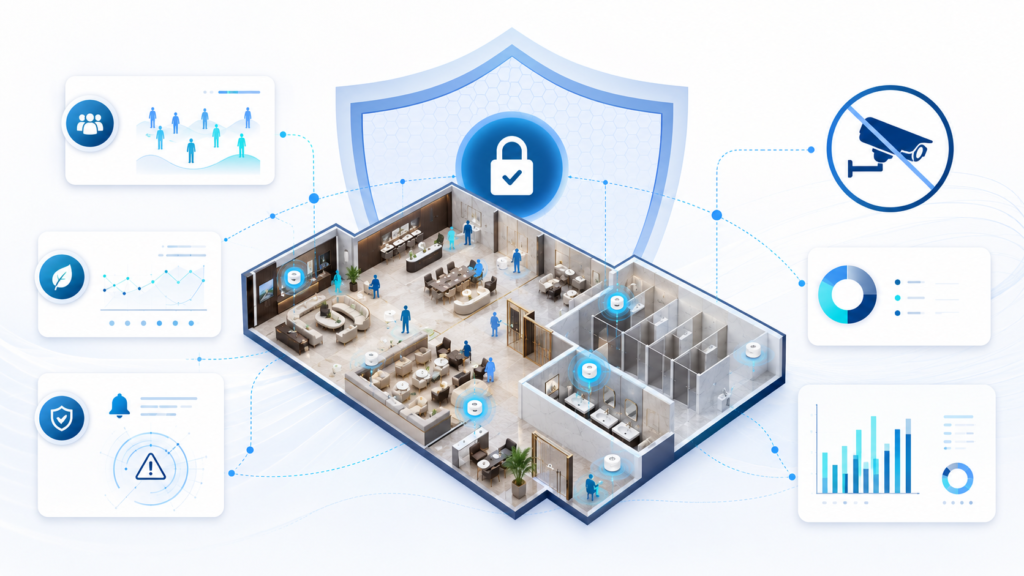
Smart environmental sensors, such as Halo sensors, can be placed throughout a shisha lounge to continuously monitor key indicators including particulate matter (PM2.5), carbon monoxide levels, humidity, and temperature. Rather than relying on how a space “feels,” operators get objective, real-time data on actual air conditions.
Real-Time Visibility Across the Venue
Different areas of a lounge often have different air quality profiles—a corner near the kitchen exhaust may behave differently from a seating area near the entrance, or an outdoor terrace may shift dramatically depending on wind conditions. Sensor placement across zones gives operators a clearer picture of where air quality issues are concentrated, rather than treating the venue as a single uniform space.
Proactive Management Instead of Fixed Schedules
When sensor data shows particulate levels rising in a specific zone—say, during a busy Friday evening with high occupancy—ventilation systems can be adjusted accordingly, or staff can be alerted to manage seating density in that area. This shifts ventilation management from a fixed schedule to a responsive system based on actual conditions.
Data-Driven Decision Making
Over weeks and months, sensor data reveals patterns: which nights and times see the highest particulate levels, which zones consistently underperform on ventilation, and how seasonal changes (such as switching between indoor and outdoor seating) affect overall air quality. This allows operators to make informed decisions about ventilation upgrades, layout adjustments, or staffing of high-smoke areas—based on evidence rather than assumption.
Key Benefits
Improved Safety Continuous monitoring of carbon monoxide and particulate levels helps ensure conditions remain within safe ranges for both guests and staff working extended shifts in these environments.
Better Operational Efficiency Ventilation systems can run based on actual demand rather than fixed schedules, reducing unnecessary energy use during quiet periods while ensuring adequate extraction during peak hours.
Cost Savings Data-driven ventilation management can help reduce energy costs associated with over-ventilation, while also extending the lifespan of furnishings and reducing deep-cleaning frequency by addressing air quality issues before they compound.
Improved Customer Experience Guests enjoy the shisha lounge atmosphere they expect, without the discomfort of excessive smoke buildup—supporting longer visits and repeat custom.
Better Environmental Conditions Consistent monitoring helps maintain a more stable balance between ambiance and air quality, particularly important in mixed-use venues where shisha areas are near other guest spaces.
Enhanced Decision Making Historical data supports decisions on ventilation system upgrades, seating layout changes, and capacity planning—backed by evidence specific to the venue rather than generic industry assumptions.
Real-World Use Cases
Hotel Rooftop Shisha Lounges: A hotel in Dubai Marina with a rooftop shisha terrace uses air quality sensors to monitor conditions near the boundary with the adjacent rooftop restaurant, ensuring smoke doesn’t drift into non-smoking dining areas during busy evenings.
Standalone Shisha Cafes: A popular shisha cafe in Abu Dhabi uses zone-based sensors to identify that one section of the venue consistently shows higher particulate levels during weekend evenings, leading management to adjust seating density and improve extraction specifically in that zone.
Mixed-Use F&B Venues: A restaurant and lounge concept in Sharjah with both indoor dining and an outdoor shisha terrace uses sensors to monitor how outdoor smoke levels change with seasonal wind patterns, helping staff make real-time decisions about which outdoor sections to open on any given evening.
Multi-Level Lounges: A multi-floor shisha lounge in Dubai uses sensors on each level to compare air quality performance across floors, revealing that the ground floor ventilation system needed recalibration compared to the upper level—an issue that had gone unnoticed through visual checks alone.
Frequently Asked Questions
1. Can sensors really make a difference if shisha smoke is part of the venue’s appeal? Yes. The goal isn’t to eliminate smoke, but to ensure ventilation keeps pace with it—maintaining the ambiance guests expect while avoiding conditions that become genuinely uncomfortable or unsafe.
2. What exactly do these sensors measure? Typically particulate matter (PM2.5), carbon monoxide, temperature, and humidity—giving a clear picture of overall air quality in real time.
3. Do sensors require constant monitoring by staff? No. Sensors can be configured to send alerts only when readings move outside acceptable ranges, so staff are notified when action is needed rather than having to watch dashboards continuously.
4. Can this help with energy costs? Yes. By understanding actual air quality conditions throughout the day, ventilation systems can be adjusted to avoid running at maximum capacity unnecessarily during quieter periods.
5. Is this relevant for outdoor or semi-outdoor shisha terraces? Yes. Sensors can monitor outdoor and semi-enclosed areas as well, which is particularly useful given how much UAE shisha lounges rely on terrace seating during cooler months.
6. How does this support compliance efforts? Continuous air quality data provides an objective record of conditions in shisha areas, which can support discussions with health and safety authorities or building management regarding ventilation performance.
7. Will guests notice the sensors? No. Environmental sensors are typically small, discreet devices that don’t capture images or audio and blend into the venue’s existing décor.
8. How long does it take to start seeing useful data? Many operators begin identifying patterns—such as peak particulate times or underperforming zones—within the first few weeks of monitoring.
Conclusion
Air quality in shisha lounges sits at an interesting intersection: it’s central to the guest experience, yet often managed with the least amount of objective information of any aspect of venue operations. For UAE operators—whether running a standalone lounge, a hotel rooftop terrace, or a mixed-use F&B venue—understanding what’s actually happening in the air isn’t about changing what makes shisha lounges appealing. It’s about making sure ventilation systems, layout decisions, and staffing genuinely match real conditions rather than assumptions.
Taking stock of your current setup is a useful starting point: how is air quality currently assessed in your venue, and how confident are you that your ventilation is keeping pace with actual demand across different zones and times of day?
How SmartSensors Can Help
smartsensors.ae supports UAE hospitality and F&B venues with environmental monitoring solutions tailored to spaces like shisha lounges. Our Halo smart sensor solutions can provide:
- Indoor air quality monitoring – tracking particulate matter, carbon monoxide, and other key indicators in real time
- Occupancy monitoring – understanding how seating density relates to air quality across different zones
- Vape detection – relevant for mixed-use venues where vaping policies differ from shisha areas
- Environmental monitoring – temperature and humidity tracking to support overall comfort
- Privacy-safe monitoring in sensitive areas – for any adjoining spaces such as restrooms or private lounges
- Real-time alerts and reporting – giving operators the information needed to manage ventilation proactively
If your venue is looking to better understand its air quality performance—without disrupting the atmosphere guests come for—our team can discuss how monitoring might apply to your specific layout and operations.