A general manager at a hotel in Business Bay opens the monthly utilities report and notices something odd: electricity consumption is up 18% compared to the same month last year, despite occupancy being roughly the same. Maintenance checks the chillers, the lighting systems look fine, and nothing seems obviously broken. Eventually, after weeks of investigation, the engineering team discovers that HVAC units in a block of unoccupied rooms have been running continuously — set to full cooling, with no one to switch them off.
This is not an unusual story. Across hotels in the UAE, buildings are full of systems running on assumptions rather than real data — assumptions about occupancy, air quality, energy use, and space utilization. When those assumptions are wrong, the costs show up quietly: in utility bills, in maintenance callouts, in guest complaints about stuffy rooms or noisy corridors, and in missed opportunities to use space more effectively.
For facility managers, hotel operators, and property owners, the question is no longer whether to adopt smart building technologies — many already have some smart systems in place. The real question is whether those systems are giving genuinely useful, real-time information, or simply automating old habits. This article looks at the operational and financial impact of relying on outdated building management approaches, and how smart sensor technology is helping UAE hotels close the visibility gap.
UNDERSTANDING THE PROBLEM
Most hotel buildings in the UAE were designed and built with a certain level of automation — building management systems (BMS) that control HVAC, lighting, and energy distribution based on schedules and fixed setpoints. These systems work well in theory, but they rely on static rules: rooms are cooled to a set temperature whether occupied or not, lighting follows a timer regardless of whether anyone is in the corridor, and air handling units run at the same rate throughout the day.
Common Causes of Inefficiency
- Occupancy assumptions don’t match reality. A room marked as “occupied” in the property management system may sit empty for hours if a guest checks out early or is out for the day, yet HVAC continues running at full capacity.
- Manual monitoring across large properties is impractical. A hotel with 200+ rooms across multiple floors simply cannot have engineering staff physically checking conditions room by room throughout the day.
- Systems operate in isolation. HVAC, lighting, security, and air quality systems often don’t share data with each other, meaning no one has a complete picture of what’s happening across the building at any given moment.
- Reactive maintenance culture. Many issues — a malfunctioning AC unit, a space with poor air circulation, an underused meeting room — are only addressed once someone complains or a system fails completely.
Why This Is Hard to Solve
Part of the challenge is that these inefficiencies are individually small. A few rooms running AC unnecessarily, a meeting room with stale air, a corridor lit all night with no one walking through it — none of these feel urgent on their own. But across a property with dozens of rooms and common areas, operating 365 days a year, these small inefficiencies add up into a significant ongoing cost that’s difficult to see without the right data.
IMPACT ON BUSINESSES
Financial Impact
Energy costs are one of the largest controllable operating expenses for UAE hotels, particularly given the cooling demands of the climate. Rooms and common areas that are conditioned when unoccupied, lighting that runs longer than necessary, and HVAC systems that aren’t adjusted based on actual usage patterns all contribute to inflated utility bills — often without anyone realizing exactly where the waste is occurring.
Operational Impact
Without real-time data, engineering and facilities teams spend much of their time on reactive tasks — responding to guest complaints about temperature or air quality, manually checking room conditions, or troubleshooting systems after something has already gone wrong. This reactive approach means staff time is spent firefighting rather than on planned, preventive work.
Guest and Employee Experience Impact
Guests notice when a room feels stuffy, when a meeting room is too warm for a long presentation, or when a corridor smells of cigarette smoke that lingers from hours earlier. Employees working in back-of-house areas — kitchens, laundry rooms, storage spaces — are also affected by poor ventilation or temperature extremes, which can impact comfort and productivity over time.
Compliance and Risk Implications
Hotels in the UAE are expected to maintain certain standards around air quality, fire safety, and energy efficiency, particularly as sustainability reporting becomes more relevant to hotel groups and tourism authorities. Without data to demonstrate how spaces are actually being used and maintained, it becomes harder to identify where improvements are needed or to respond to audits and certifications with confidence.
TRADITIONAL APPROACHES AND THEIR LIMITATIONS
Most hotels currently rely on a combination of the following:
- Building Management Systems (BMS) with fixed schedules — useful for basic automation, but typically based on time-of-day rules rather than actual occupancy or environmental conditions.
- Periodic manual inspections — engineering staff doing rounds to check AC units, lighting, and general conditions, but only a handful of times per day at most.
- Guest and staff feedback — relying on someone noticing and reporting an issue, by which point the guest experience has often already been affected.
- Standalone smoke detectors — designed for fire safety, but not for general air quality monitoring or detecting issues like vaping.
The shared limitation across these approaches is that they provide a snapshot, not a continuous picture. A BMS schedule doesn’t know that a room is empty three hours early. A manual inspection at 10 a.m. doesn’t reflect what’s happening in that space at 2 p.m. Hotels end up managing buildings based on assumptions, schedules, and occasional checks — rather than on what’s actually happening in real time.
HOW SMART SENSORS HELP
Smart sensors add a layer of real-time, granular data to existing building systems — without requiring a complete overhaul of HVAC, lighting, or BMS infrastructure.
Continuous, Real-Time Monitoring
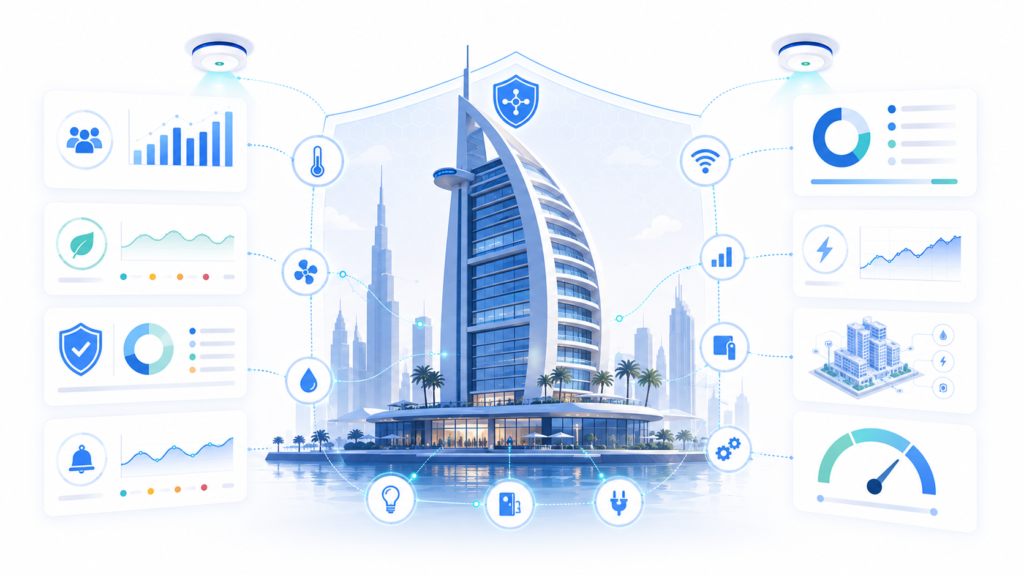
Small sensors placed in guest rooms, corridors, meeting rooms, and back-of-house areas continuously track conditions such as occupancy, temperature, humidity, air quality, and in some cases, the presence of vape aerosols. This data is available in real time, rather than being captured only during periodic checks.
Visibility Across the Property
Instead of relying on staff to physically visit each space, facility managers can view a live picture of conditions across multiple floors and zones from a single dashboard — making it possible to spot patterns that would otherwise go unnoticed, such as a particular wing of the hotel consistently running warmer than others.
Proactive, Rather Than Reactive, Management
When a sensor detects that a room has been unoccupied for an extended period while HVAC continues running, or that air quality in a conference room is declining during an event, staff can be alerted and take action before it becomes a guest complaint or a wasted resource.
Data That Supports Better Planning
Over weeks and months, sensor data builds a picture of how spaces are actually used — which meeting rooms are underutilized, which guest room floors have higher energy consumption, or which areas consistently show air quality concerns. This information helps facility managers and decision-makers plan upgrades, adjust schedules, and justify investments with real evidence rather than guesswork.
KEY BENEFITS
- Improved Safety — Continuous monitoring of air quality and detection of vape aerosols helps identify issues that traditional smoke detectors are not designed to catch, supporting a safer environment for guests and staff.
- Better Operational Efficiency — Facilities teams can shift from routine, blanket checks to targeted responses based on real alerts, freeing up time for planned maintenance and improvement projects.
- Cost Savings — Identifying HVAC running in unoccupied spaces, optimizing lighting based on actual usage, and reducing unnecessary energy consumption can meaningfully reduce utility costs over time.
- Improved Customer Experience — Consistent room temperatures, better air quality in meeting spaces, and faster response to comfort issues all contribute to a smoother guest experience — often without guests ever being aware of what’s happening behind the scenes.
- Better Environmental Conditions — Real-time air quality data helps engineering teams fine-tune ventilation across different zones, from guest rooms to ballrooms to back-of-house kitchens and laundry areas.
- Enhanced Decision Making — Property-wide data supports better planning — from energy efficiency initiatives to space utilization decisions — backed by evidence rather than assumptions.
REAL-WORLD USE CASES
Use Case 1: Reducing Energy Waste in Unoccupied Rooms A hotel in Sharjah uses occupancy sensors across guest room floors to identify rooms where HVAC continues running well after a guest has checked out or left for the day. By integrating this data with the building management system, the engineering team adjusts cooling schedules for those rooms, reducing unnecessary energy use without affecting guest comfort during actual stays.
Use Case 2: Air Quality Management in Event Spaces A hotel in Dubai hosting frequent weddings and corporate events uses environmental sensors in ballrooms and pre-function areas to monitor CO2 and humidity levels during large gatherings. When levels begin to rise during a busy event, the system alerts the engineering team to increase ventilation — helping maintain a comfortable environment for guests without manual spot-checks throughout the event.
Use Case 3: Identifying Underused Meeting Rooms A business hotel near Dubai International Airport uses occupancy sensors in its meeting rooms to understand actual usage patterns over several months. The data reveals that two smaller meeting rooms are rarely booked during certain hours, prompting the sales team to adjust pricing and packaging for those time slots — turning underused space into additional revenue opportunities.
Use Case 4: Monitoring Back-of-House Air Quality A resort property uses environmental sensors in kitchen and laundry areas to track temperature and humidity levels, helping facilities teams identify when ventilation systems need attention before conditions become uncomfortable for staff working long shifts in these spaces.
Use Case 5: Vape and Air Quality Monitoring in Guest Rooms A hotel group with properties across the UAE deploys sensors that combine air quality and vape detection in guest rooms, giving front desk and housekeeping teams early visibility into potential policy violations or ventilation issues — before they result in guest complaints or additional cleaning costs.
HOW SMARTSENSORS CAN HELP
Smart sensor technology from SmartSensors.ae is designed to work alongside the systems hotels already have in place, adding real-time visibility where it’s currently missing. Depending on a property’s priorities, this can include:
- Indoor air quality monitoring — tracking CO2, humidity, and particulate levels across guest rooms, meeting spaces, and back-of-house areas
- Occupancy monitoring — understanding how rooms and shared spaces are actually used, without cameras
- Vape detection — identifying vape aerosols that standard smoke detectors typically miss
- Environmental monitoring — supporting HVAC optimization and energy efficiency efforts
- Privacy-safe monitoring in sensitive areas — covering staff zones, storage areas, and restricted spaces without visual surveillance
- Real-time alerts and reporting — giving facility teams timely information to act on, along with historical data to support planning and budgeting decisions
The goal is not to replace existing building management systems, but to give them better information to work with — helping facility teams move from reactive troubleshooting to proactive, data-informed management.
FREQUENTLY ASKED QUESTIONS
- Do smart sensors replace our existing building management system (BMS)? No. Smart sensors are typically designed to complement existing BMS infrastructure by providing additional real-time data that the BMS can use to make more informed adjustments.
- How quickly can a hotel expect to see results from smart sensor data? While every property is different, many facility teams begin identifying patterns — such as rooms with consistent energy waste or air quality concerns — within the first few weeks of data collection.
- Are these sensors difficult to install across a large property? Most modern sensors are compact and wireless, designed for retrofit installation without major construction, which makes property-wide deployment more practical than older wired systems.
- Can smart sensors help with sustainability reporting? Sensor data on energy usage patterns, occupancy, and environmental conditions can provide useful evidence to support sustainability initiatives and reporting requirements, though specific reporting frameworks should be confirmed with relevant consultants.
- Do these technologies require guests to download an app or interact with anything? No. The sensors operate in the background, monitoring environmental and occupancy data without requiring any guest interaction or awareness.
- Can sensor data be integrated with our existing dashboards or reporting tools? Many smart sensor systems are designed to integrate with existing property management and building management platforms, allowing data to be viewed alongside other operational information.
- Is this technology only useful for large hotels? While larger properties often see more visible savings due to scale, smaller hotels can also benefit from improved visibility into energy use, air quality, and space utilization relative to their size.
- What areas of a hotel typically benefit most from smart sensors? Guest rooms, meeting and event spaces, corridors, and back-of-house areas such as kitchens and laundry rooms tend to show the most actionable data, particularly around occupancy and air quality.
CONCLUSION
Smart building technologies are not about replacing everything a hotel already has — they’re about filling in the gaps where current systems are working on assumptions rather than real data. For UAE hotels managing significant energy costs, guest comfort expectations, and increasingly complex operations, the ability to see what’s actually happening across a property in real time can make a measurable difference to both the bottom line and the guest experience.
If your property’s HVAC, lighting, and air quality systems are still largely running on fixed schedules and periodic checks, it may be worth exploring where real-time data could help — not as a major overhaul, but as a practical step toward more informed, efficient operations.
Suggested CTA: Want to understand where your property could benefit from real-time building data? Reach out to SmartSensors.ae for a conversation about your current setup.
SUGGESTED INTERNAL LINKING OPPORTUNITIES
- Link “occupancy monitoring” to a dedicated occupancy sensor solutions page
- Link “indoor air quality monitoring” to an IAQ monitoring product page
- Link “vape detection” to a Vape Detection Sensors page (cross-link with the hotel guest safety article)
- Link “energy efficiency” or “HVAC optimization” to a relevant case study or solutions page
- Link “environmental monitoring” to a back-of-house/staff areas use case page
FAQ SCHEMA (5 QUESTIONS)
- Q: Do smart sensors replace our existing building management system (BMS)? A: No. Smart sensors are designed to complement existing BMS infrastructure by providing additional real-time data the BMS can use to make more informed adjustments.
- Q: Are these sensors difficult to install across a large property? A: Most modern sensors are compact and wireless, designed for retrofit installation without major construction, making property-wide deployment more practical than older wired systems.
- Q: Can smart sensors help with sustainability reporting? A: Sensor data on energy usage, occupancy, and environmental conditions can provide useful evidence to support sustainability initiatives, though specific frameworks should be confirmed with relevant consultants.
- Q: Do these technologies require guests to download an app or interact with anything? A: No. The sensors operate in the background, monitoring environmental and occupancy data without requiring any guest interaction or awareness.
- Q: What areas of a hotel typically benefit most from smart sensors? A: Guest rooms, meeting and event spaces, corridors, and back-of-house areas such as kitchens and laundry rooms tend to show the most actionable data, particularly around occupancy and air quality.